General Francois Cartier. Part 3 of 5: The Closed History of Open Cryptology
The continuation of the series about collecting materials on the cryptographer-general François Cartier. And how significantly the return of forgotten facts changes the established views on our history.
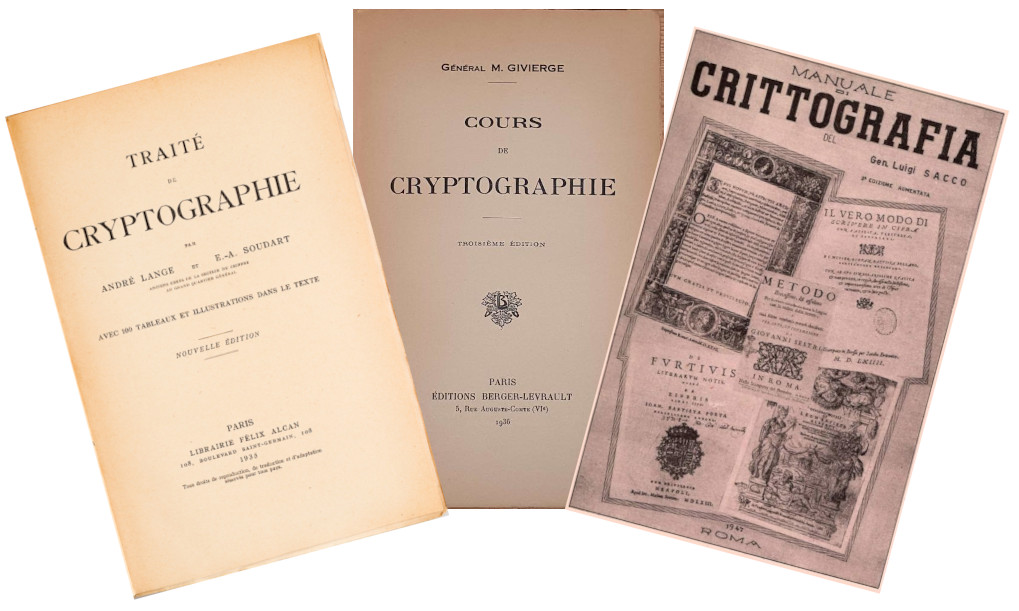
When state intelligence services disclose previously classified documents from their archives, especially interesting things usually end up on those pages that "got lost" for some reason. That is, they should have been among the disclosed documents, but unfortunately, they are not found.
One of the striking examples of this kind was detailed several years ago in the article "CIA, the Mystery of the 25th Page, and the Universe as a Hologram". In the current search for documents on Cartier, a similar story with a loss has also surfaced, but this time in declassified documents of the NSA, not the CIA. And amusingly enough, the particularly interesting missing document here also ends up being found through a similar trajectory. Without the help of NSA archives and in a rather unexpected public place...
In 2014 (for reasons clearly related to the topic of Baconian ciphers and examined in detail in the material "Bacon and Tempest" [i1]), the NSA leadership decided to declassify and put online practically all documents related to the activities of William F. Friedman. At that time, Friedman was considered one of the main patriarchs of the NSA and was called the "father of American scientific cryptology." Among the numerous disclosed files, there are naturally ones where General Cartier is mentioned — as one of the most notable military cryptographers of the early 20th century.
But there is also noted the absence of one particularly curious document from 1954. During that period, Friedman held the post of "Special Assistant to the Director of the NSA" and was simultaneously preparing (co-authored with his wife) his subsequently famous book. In which all cryptographic theories about Baconian ciphers in old books, supposedly proving Francis Bacon as the true author of Shakespearean works, are completely refuted. During this work, Friedman, being thorough, requested through military cryptographic cooperation channels with his French colleagues a biographical reference on General Cartier.
From declassified NSA documents, it is reliably known that this reference was prepared and handed over to Friedman by Lieutenant Colonel E. Arnaud (Edouard Arnaud), the then-head of the Cipher Section of the Secretariat of the French Armed Forces. But, however, only accompanying letters were declassified here. The biographical sketch itself is not found in the published NSA files...
Moreover, the "Guide to the Friedman Cryptographic Collection" [o1], published by military historian Rose Mary Sheldon in the same 2014 and also mentioning the biographical sketch from Arnaud, reports an interesting nuance: In addition to Storage Item 397 — Cartier's book "The Problem of Cryptography and History" — a document labeled Item 397.2: Arnaud, LTC. Note sur le Général Cartier is appended. That is, the same note from Arnaud, but with the notation "No card." Meaning that the catalog card for this document is missing from the Friedman collection catalog. As many other cards, it was removed — often together with the documents themselves — during multiple "cleanups" of the collection by vigilant NSA censors. [i2]
In summary, all attempts to locate this Arnaud note among available internet resources have so far been unsuccessful. But it is useful to recall that William F. Friedman was truly a virtuoso in the art of ambiguous material presentation. Therefore, among colleagues, Friedman's reports and publications were renowned for presenting facts so skillfully that even fiercely debating opponents often found there "convincing arguments" for their diametrically opposite views. [i3]
So, in our case, if one carefully studies the Friedmans' book "The Shakespearean Ciphers Examined" [o2], one can find the following passage on pages 248-249:
We were given an appreciatory note of him [Cartier], prepared specifically for us in May 1954 by Lt.-Col. Arnaud, head of the Cipher Section of the Secretariat of the French Armed Forces, and we quote from it with his permission:
General Cartier was early attracted to cryptographic studies. From 1900 to 1912 he was Secretary and also the most active member of the Commission for Military Cryptography headed successively by Generals Penel, Berthaut and de Castelnau. In 1912 he was appointed Head of the Cipher Section at the Ministry of War, and he remained in this position until 1921.
It was during that period, and primarily during the war of 1914- 1918, that his great competence and the distinguished record of the group of cryptologists inspired by him brought his name into prominence and gave him a fame which spread beyond the frontiers of France.
The name of General Cartier is destined to remain in the roll of first-rate cryptologists in the history of national and international cryptography, as much for the direction and impetus which he gave to cryptographical research as for the invaluable successes scored under his leadership.
Regardless of whether this is the full content of the "biographical note" from Arnaud or just a part, the lines quoted here are quite sufficient to understand the main point — how highly military cryptographers of that time evaluated Cartier's activities and competence.
And if, in the light of these evaluations, one carefully studies the materials of the "Analytical Guide to the Friedman Collection" [o1] in comparison with the "Analytical Bibliography of the Literature of Cryptology" [o3] by Joseph Galland, one can discover something quite unexpected. The powerful processes of the "open cryptography movement" (as it would be called now) were directly initiated by General Cartier in the 1920s.
Or, in the words of Arnaud, what direction and impetus François Cartier gave to cryptographic research, and what successes were achieved by those cryptographers he led. And also, through what and whose publications did Cartier's fame spread far beyond the frontiers of France...
When in 1921 General Cartier completed his service as the head of the French Cipher Bureau, his closest associate, Colonel Marcel Givierge, then took over this organization. Some time later, he received the rank of general — in recognition of this officer's outstanding merits in the field of cryptography during the war.
For our story, however, the particular interest lies not so much in the military achievements of the general, but the fact that already in 1922 Marcel Givierge actively joined — following Cartier — into the promotion of cryptography to the general public. In the September issue of the magazine "Civil Engineering" (that is, simultaneously with Cartie r's article about Bacon's secret biography encrypted with his biliteral cipher), he published the article "Cipher Machines and their Application in Wireless Telegraphy" [o4]. Six months later, in March 1923, the magazine "Science and Life" published another overview article by Givierje — "Cryptography and Cipher Machines" [o5].
A year later, in the summer of 1924, "French Military Review" published two very substantial articles by the general under the common title "Problems of Ciphers" [o6]. And in 1925, Givierge's magnum opus, "Cryptography Course" [o7], was published, which was repeatedly republished afterward and translated into foreign languages in other countries. The book contains a general theory of cipher strength, descriptions of cryptographic schemes, methods, and examples of analytical decryption of various ciphers and codes. According to William Friedman's competent assessment [o3], "This book, undoubtedly the best and most important on cryptanalysis ever published" [by the mid-20th century].
The year 1925 turned out to be exceptionally fruitful for the wide popularization of cryptography and the revelation of many of its occult secrets. That same year, it can be reminded, François Cartier began the publication of a large series of articles, united under the common title "Secrets of Radiotelegraphy" and telling about new electromechanical cipher devices.
And also in 1925, a pair of former cryptanalyst collaborators of Cartier during the war, André Lange and Émile-Arthur Soudart, released another very notable book "Treatise on Cryptography: Studies of Secret Writing" [o8]. In this work, aside from substantive information on the history of ciphers and encryption theory, numerous examples and methods of breaking ciphers are also provided, plus a quality list of additional literature of about a hundred items. Alongside Givierge's monograph, this work gained the status of one of the best cryptography books of its time.
For our study, it is especially important that both educational guides from the military cryptographers of the French Cipher Bureau — both from Givierge and from Lange-Soudart — not only cite General Cartier with noticeable respect but also detail many aspects of the Bacon cipher. Including the topic of Cartier's cryptanalytical research on deciphering Baconian messages in books from the Shakespearean era.
Among other notable — and very consonant — cryptographic events of that time, happening in many other countries besides France, according to Galland's "Bibliography", the substantial publications in Belgium, Sweden, Austria, the Netherlands, etc., can be noted. Particularly noteworthy in the context of this "first era of open cryptography" should be the events in Italy, Germany, and the USA.
In Italy, Colonel (and soon after General) Luigi Sacco, known in the country as one pioneer of military radio communication, in 1925 published the first edition of his "Cryptography Handbook" [o9]. Which eventually — corrected and expanded by the author — would be repeatedly republished and translated into other languages. As another good text for general acquaintance with the subject.
In Germany, the quite renowned academic mathematician Georg Hamel published several works describing the scheme and his (amateur) analysis of the strength of the Kryha apparatus, one of the first commercially available cipher machines that appeared on the market in the mid-1920s [o10]. Among professionals in military cryptography, this work became an exemplary case of how deeply even a very authoritative mathematician can err in such matters if he does not possess the special skills and training in cryptanalysis. (Specifically the Kryha system, which Hamel assessed as "unbreakable without knowledge of the key," professionals of American intelligence cracked in about three hours.)
In the USA, where the well-known to us William F. Friedman in the 1920s had virtually no dealings with the secret affairs of military intelligence, as he was engaged in strengthening the American army’s own ciphers, other quite interesting events occurred. Carefully observing the publications happening in Europe, making translations of new cryptographic manuals (and possessing his obvious talents for cryptanalysis), Friedman clearly very much wanted to establish himself officially as an informed and authoritative expert in the rapidly burgeoning field of "open cryptography."
For this, Friedman sought (and at a very high cost [i4]) to gain recognition of his authorship for a series of important cryptanalytic brochures he prepared during work at Riverbank Laboratories (1917-1920). Some of these brochures, received by Cartier from the USA through Fabian, had already gained recognition anonymously in Europe as "Riverbank publications." Now, officially securing the fact of his authorship, Friedman personally handed these really significant works of their time to the US Library of Congress.
Then, in 1927, for the new edition of the Encyclopædia Britannica, Friedman prepared a large article "Codes and Ciphers". In previous editions of the encyclopedia, there was already a substantial article "Cryptography", but now — in tune with the times — the editorial board commissioned Friedman to produce yet another large article "on modern, highly scientific" cryptosystems (see [o1], Item 8). Since 1929, this article has been firmly established in the pages of the 14th and subsequent editions of the Britannica.
Summarizing all these fascinating and today very little-known matters in the cryptography of the 1920s, one can state the following.
Historians have more than enough documents and facts convincingly showing that the extraordinarily fruitful and beneficial for the progress era of open cryptology, which began in the mid-1970s, could have actually started half a century earlier. But at that time, it wasn't initiated by amateur university scholars who, apart from their own curiosity, had no cryptographic knowledge, but by advanced professional cryptographers of military intelligence with many years of practical experience.
These professionals provided civil society with almost everything for further scientific development. The general theory of cipher strength. Descriptions of basic and advanced cryptanalysis methods relying on strong mathematical tools. Descriptions of almost all popular ciphers in history, including the most modern electromechanical ciphers at that time and the methods for cracking them. As well as numerous practical examples with solutions, including real cipher systems from the recent big war.
In short, civil society already had absolutely everything in the 1920s for the serious development of cryptographic science — including the undeniable interest in the topic from banking/commercial structures. Convincing evidence of this is not hard to find. It is significantly more challenging to see and understand why absolutely nothing similar to an open cryptography revolution happened at that time.
Because the clear tendency towards complete disclosure of cryptology secrets through that era was quickly and effectively overturned. Exactly who and how managed to do this is significantly harder to explain, as it was all done behind closed doors without public announcements. The obvious result of these efforts was that after the Second World War, the public, in essence, was not allowed to know almost anything about the secrets of cryptology. And the complex of important open-cryptographic events of the 1920s was so completely forgotten that almost no one knows about them today.
One of the accompanying effects of this universal forgetfulness was the almost complete removal of General Cartier from history. As a person who not only wrote a very important book about Bacon and his cipher but essentially began the open cryptography revolution in the 1920s.
Carefully analyzing Cartier's biography — reliable facts, factoids, and deliberately invented untruths about him — helps to understand how one reality is substituted for another for the public. And people notice nothing. And remember nothing...
Further Reading
[i1] Bacon and Tempest
[i2] Bacon, Shakespeare, and the NSA's 'Cut the Ends!' Reflex
[i3] Bacon and Pearl Harbor — Hiding the Truth
[i4] Aristotle at the Trojan War and "Traitor Founders" in the NSA Hall of Honor
Main Sources
[o1] Rose Mary Sheldon. The Friedman Collection: An Analytical Guide, 2014
[o2] William F. Friedman and Elizebeth S. Friedman, The Shakespearean Ciphers Examined An Analysis Of Cryptographic Systems Used As Evidence That Some Other Author Than William Shakespeare Wrote The Plays Commonly Attributed To Him (Cambridge University Press, 1958)
[o3] Joseph S. Galland. An Historical and Analytical Bibliography of the Literature of Cryptology. Evanston, Ill.: Northwestern University Press, 1945
[o4] Marcel Givierge. «Les machines a cryptographier et leurs applications dans la telegraphie sans fil.» Genie Civil, Paris, Sept. 2, 1922, Vol. 81, pp. 218-220.
[o5] Marcel Givierge. «La cryptographie et les machines a cryptographier.» La Science et la Vie, Paris, mars 1923, pp. 223-231.
[o6] Marcel Givierge. «Questions de chiffres.» Revue Militaire Franсaise, Paris, 94° annee, Nouvelle Serie, No. 36, 1er juin 1924, pp. 398-432; No. 37, 1er juillet 1924, pp. 59-78.
[o7] Marcel Givierge. Cours de cryptographie. Paris: Berger-Levrault, 1925.
[o8] Andre Lange et Emile-Arthur Soudart. Traite de cryptographie: études sur les écritures secrêtes, Paris: Librairie Felix Alcan, 1925
[o9] Luigi Sacco (Generale). Manuale di crittografia. 2a edizione, riveduta e aumenta. Roma, 1936 (Первое издание было выпущено в 1925 г на средства автора и под названием Nozioni di crittografia.)
[o10] Georg Hamel. Die Chiffriermaschine System Kryha. Berlin, 1927; Georg Hamel. The Kryha ciphering machine — A mathematical opinion. Berlin, (circa 1929)