General Francois Cartier. Part 4 of 5: Truth, Lies, and Factoids
The continuation of the series on gathering materials about the cryptographer general, who was long cut out of 20th-century history. This episode focuses on the layers of that dense veil of falsehoods and secrets covering the "Taboo of Cartier."
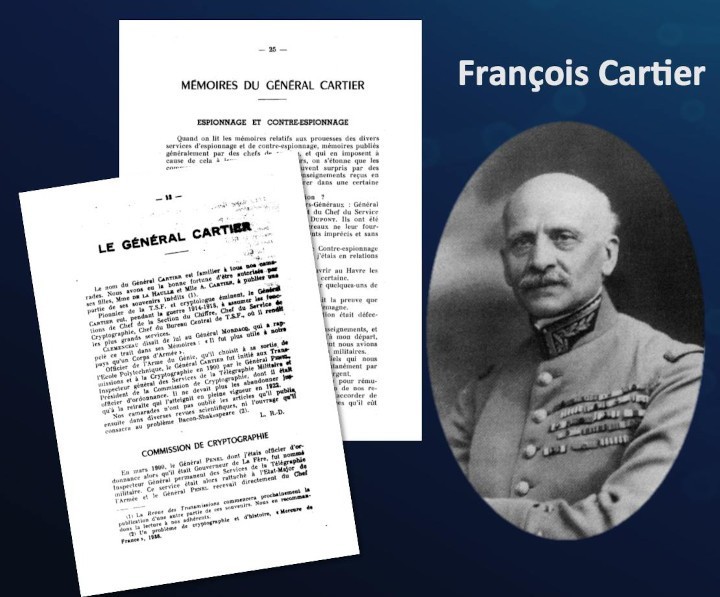
When delving into this major topic of the "removal" of General François Cartier from 20th-century history, it quickly becomes apparent that the Bacon-Shakespeare problem is far from the only reason. It's just the top layer — most noticeable and undoubtedly important — of a large and multi-level structure of secrets. So, beneath the top layer, if one digs deeper, entirely different levels and connections are revealed. No less serious, but long and carefully concealed. Hence, almost unknown to the public.
These secret layers are very important for a significantly different, clearer understanding of events in the turbulent history of the 20th century. And it's necessary to emphasize that we're talking about events that General Cartier's views and actions continued to influence at times when he had long stepped back from affairs...
To make clearer what is meant here, it's useful to quote a fragment from a remarkable book about the role of cryptography in history. By an intriguing — and almost certainly not accidental — coincidence, it was published in the US in 1967. That is, almost simultaneously, but somewhat earlier than the far more famous monograph "The Codebreakers" by David Kahn.
The other book, by an author named Ladislas Farago, was titled "The Broken Seal" [o1] and with many previously unknown details, it told about the secret struggle of American and Japanese cryptographic services between the World Wars. In other words, it seemingly had nothing to do with the hero of World War I, French General Cartier, and his Bacon-Shakespearean pursuits in the post-war period.
Nevertheless, the pages of the book reveal previously unknown information about Cartier — in a very unexpected context of strengthening cryptographic protection for communications and intelligence services in militarist Japan... The related fragment from Farago's book reads as follows [with our emphasis on the core message]:
[Foreign Ministry Cable Section Chief] Shin Sakuma was not a professional cryptographer but a career Foreign Service officer. ... [Knowing about cryptanalitic successes of the US intelligence], Sakuma decided to seek means to improve the safety of his Ministry's classified traffic. The Japanese imported a Frenchman, regarded at that time as the world's foremost cryptographer. He was Brigadier General Henri [sic] Cartier, whose verts — transcripts of decrypted German messages distributed in France on green foolscap — had contributed materially to the Allied victory in World War I.
He did much to improve Japan's crypto-system by training a new generation of native cryptologists and by developing a series of complex codes and ciphers. His most important contribution, however, was his contagious enthusiasm for cryptographic machines at a time when many of the professionals were still opposed to them.
The most outstanding feature of this fragment is that for more than half a century after the publication of Farago's "The Broken Seal," NOT A SINGLE serious piece of cryptography research has surfaced to confirm this episode with documents or participant testimonies.
For this reason, it's entirely natural to ask questions. Who was Ladislas Farago, who possessed a wealth of unknown information about intelligence secrets? Why was his book about military cryptography secrets published in 1967? Who needed, and why, at that time, to make this strange "factoid drop" about General Cartier?
Before beginning excavations and searches for answers, however, it's wise to clarify the terminology. Because, though important concepts like "truth" and "falsehood" are reasonably clear without explanation, terms like "factoid" or "flush tank of spies" require at least minimal comments.
The term "factoid" was introduced in the early 1970s by writer Norman Mailer in his biographical book on movie star Marilyn Monroe. It originally referred to unverified information that wasn't factual but was spread by the press as if it were true. The new term was eagerly adopted by colleagues, and as the meaning of "truth" became increasingly blurred in the media, "factoid," thanks to CNN, began to refer to any such information from news agencies that "seems to be true" and is published without thorough verification. In short, nowadays "factoids" are what "is written in newspapers/magazines/books and talked about on TV."
For those unaware, it's worth clarifying that in this interpretation, factoids fully correspond to the concept of "truth" according to those "credibility criteria" used for placing information on Wikipedia [i1]. As for the real grain of truth in a specific factoid, further investigation is always necessary.
Regarding the lesser-known term "flush tank of spies," in the writing community, tirelessly embedding various factoids in people's minds, the words are applicable to denote that special group of authors who are abundantly supplied with information by competent government bodies. If "flush tank" seems offensive to some, a more respectable term exists in American usage, such as "strategic intelligence writer."
Given the antiquity of the professions of espionage and journalism, it's likely that flushing tanks or strategic writers (to taste) have always existed for intelligence services. However, Ladislas Farago, who interests us particularly, was not only a prolific but an undoubtedly talented author of this kind. Unfortunately.
Despite the numerous errors and frame-up of facts, not to mention documented lies experts find abundantly in Farago's texts, his books are still reprinted and cited in studies on intelligence and wars of the 20th century.
To concisely outline the life path of this author, who was born in Hungary in 1906, Farago began his adult life as a journalist in Berlin at the transition from the 1920s to the 1930s — right at the start of the dramatic shift from the Weimar Republic to Hitler's dictatorship and Nazism. Sensing the situation, Farago moved from Europe to the USA, where he gained renown not only as a lively journalist but also as an expert in Hitler's propaganda methods — publishing in 1941 the book "German Psychological Warfare."
Then, when the US entered World War II, Farago became an analyst for the ONI, the Office of Naval Intelligence. Unofficial reports, allegedly from Farago himself, claimed he once held a significant position as head of the department of research and planning there. After the end of World War II, Farago officially left intelligence, actively switching to Cold War propaganda battles against communists.
In that domain, as an editor of several journals, consultant for "Radio Free Europe," and other propaganda outlets, and later as an "independent researcher" on military-intelligence topics, Farago published numerous materials and books that amazed readers with many previously unknown details.
Because it is this privileged position of the strategic flush tank, closely connected with intelligence services and regularly receiving unique documents from them. These documents often are skillful mixture of manipulated facts and disinformation, half-truths, and true details of a compromising nature. After appropriate writer’s processing, all such materials are dumped into the press or documented investigative books by the flushing tank. For the purposes of "strategic management of the system," as intelligence and Deep State theorists call it.
We will concentrate on the specifics of the compromising material leaked by intelligence through Farago and his book "The Broken Seal," as this helps dissect those multi-layered veils of cryptographic mysteries, lies, and factoids, under which the truth about François Cartier turned out to be at the same time.
Pearl Harbor Layer
The full title of Farago's book was: The Broken Seal: The Story of "Operation MAGIC" and the Pearl Harbor Disaster. The strategic purpose of this work was briefly and eloquently clarified by the following "competent review" (published, in particular, on the cover of the 2012 reissue):
"A good history of Japanese and American code-breaking operations between 1921 and December 7, 1941 ... Farago is important because in this technical study of cryptology he has arrived independently at the same general conclusion as did the non-revisionist diplomatic historians: [in the Pearl Harbor Disaster] there was no plot by Roosevelt or his advisers."
About the causes of the disaster and the key role of cryptography in the U.S. fleet's crushing defeat at Pearl Harbor, quite a lot was written even in the mid-1960s. And by now, much more. Because the heated debates on this matter cannot be considered closed, and a scientific consensus is still quite distant. Indirect evidence of this is in the many reissues of Farago's book to the present day.
On the reasons for these radical disagreements and the types of powerful facts supporting the arguments of "revisionists of official history," briefly but substantively and with rare/little-known documents, is being told in the material "Concealing the Truth" [i2].
Here, however, we are particularly interested in two completely different, previously unknown, and very powerful compromising documents revealed in Farago's book, with an obvious submission from intelligence services. The most noteworthy feature of these compromising pieces is that historical science still hasn't managed to properly digest them...
Each of these two documents, discovered in the secret archives of Japan's Ministry of Foreign Affairs after the 1945 Allied victory, unambiguously indicated that the "founding fathers" of American military cryptology independently came (one in 1925, the other in 1928) to the Japanese embassy to report the successful breaking of Japan's ciphers by U.S. intelligence cryptanalysts. The first approach was made by William F. Friedman, and the second by Herbert O. Yardley (details can be found in materials [i3]).
Sharing such information with a foreign power is considered treason and a serious state crime in any country. The essence of the intrigue in this situation lay in the fact that Ladislas Farago vividly and in detail, with full names and amounts paid for services, described in his book the treason of Herbert Yardley, who had died about ten years earlier. Yet, about the identity of other traitor, William F. Friedman, alive in 1967, Farago's book was entirely silent. Even though Friedman's name appeared twice, clearly, in the secret dispatch of Japan's Ministry of Foreign Affairs from 1925, both in Japanese and English. You just have to look at the actual document in the archive. But, for some reason, none of the historians did.
However, our task here is not to delve into historians' peculiarities with important documents but to understand the aims behind intelligence leaks through Farago's book. Because on the same pages where the author talks about secret treasonous aid to the Japanese by famous American cryptographers, details are also provided about knowledgeable consultants from other countries — Poland and France.
Where Farago detailed General Cartier's role in strengthening Japan's Ministry of Foreign Affairs' crypto-protection, a few paragraphs earlier, he discussed Jan Kowalewski's contribution, a Polish cryptologist, to strengthening Japanese military cryptography:
In 1925 the Imperial Navy had added a communications intelligence branch to the Fourth (Communications) Bureau of the Naval General Staff. Headed by Captain Jinsaburo Ito, it had a “radio detection center” at Tachibana Mura and a “research” section in Tokyo, to “analyze” the crypto-systems of other navies. A Polish expert, Captain Jan Kowalewski, was hired to teach Japanese personnel cryptology in all its ramifications.
There is a substantial degree of truth in this paragraph regarding actual historical facts. A prominent member of Polish intelligence and, in essence, the creator of the cryptologic service of new Poland, which regained statehood in 1918, Jan Kowalewski indeed visited Japan for a three-month visit to share with Japanese military his experience of successfully breaking Soviet ciphers and strengthening their own codes. For this, he was awarded one of Japan's highest national honors, the Order of the Rising Sun. However, this visit occurred a bit earlier, in the beginning of 1923, and Kowalewski arrived not as a hired specialist but as an active member of a friendly intelligence service — at the earnest request of the Japanese military attaché in Warsaw.
If, in light of current knowledge on the subject, one carefully reads the next paragraph of "The Broken Seal" — regarding the assistance to the Japanese from the Frenchman Cartier, paying particular attention to the notes and references Farago provides as sources for his information, a constructed factoid typical of the author's inventive fantasies is revealed:
In 1912 Cartier was made chief of the Cipher Section at the Ministry of War, then became head of the cryptological services of the Deuxième Bureau of the General Staff. After leaving the French army in 1919, he became available as a consultant and thus worked for various foreign governments as well as individuals.
For Cartier, see “Souvenirs du Général Cartier,” by François Cartier, Revue des Transmissions (July–Aug. 1959), pp. 23–39, and (Nov.–Dec. 1959), pp. 13–51, and his writings on cipher machines (q.v.).
Here we see how immediately after a factual statement (head of the Ministry's cryptography service in 1912), a minor error follows (in fact, the cryptography division in the General Staff was headed by Marcel Givierge, Cartier's deputy and close associate), and then a much more serious distortion follows. Cartier's retirement from the army was not in 1919 but in 1922 (which is significant, as the general's first open publications on cryptography began in 1921, while he was head of the cryptography service). Farago completely overlooked the fact that immediately after retirement, Cartier began to widely promote cryptography and cipher machines in the mass media. Instead, he added "Cartier's work for various foreign governments" as a crypto consultant.
Cryptography historians know reliably that similar consulting work on a commercial basis was indeed carried out by the head of the "Black Chamber of the USA," Herbert Osborne Yardley (when he was jobless due to the abrupt disbandment of his super-secret unit by the new government administration). However, the information about General Cartier, who, it turns out, had a similar business of training foreign states in breaking other people's ciphers and strengthening their own, became known only to Ladislas Farago somehow.
When David Kahn was preparing his comprehensive monograph "The Codebreakers" full of such information, he used the same sources mentioned by Farago regarding Cartier. However, Kahn's book contains absolutely nothing about the French general's business as a consultant to Japan or other foreign powers. But it does include the following paragraph in the notes to the chapter on Japanese cryptography during the period of interest:
Other information that came to my attention too late to include in my text is in Ladislas Farago, The Broken Seal (New York: Random House, 1967). Farago’s material must, however, be used with great caution, as it has many errors.
What a knowledgeable and truly independent researcher perceived as numerous errors in 1967, today — when the greatest cryptographic secrets have already been uncovered — appears as a series of deliberate distortions of truth to conceal precisely those unknown crypto-secrets of that era. Now it is almost impossible, perhaps, to determine what Farago intentionally distorted himself and what his sources in intelligence services constructed from facts, factoids, and outright lies. However, it is quite possible to establish (more accurately, to reasonably assume) with which "operational-strategic" purposes the truth was distorted and disinformation inserted here.
This is done roughly as follows. Today it is not very difficult to reconstruct the sequence of interconnected events that preceded the almost simultaneous releases of books by David Kahn and Ladislas Farago. Knowing both the essence of these events and the things certain intelligence agencies in the mid-1960s wanted very much to conceal makes it easier to understand why various "errors and omissions" emerged in Farago's work. Starting with the strangely depersonalized compromising material on William Friedman and ending with the puzzling factoids from the life of Francois Cartier in the book about the Pearl Harbor catastrophe.
In 1961, journalist and cryptology enthusiast David Kahn signed an agreement with Macmillan to write a large book about the history and modernity of cryptography. The scale of the work was such that in 1963 Kahn left journalism to fully devote himself to preparing his Book. With extensive connections in the country and around the world, Kahn collected materials not only in libraries and archives but also through conversations, correspondences, and interviews with knowledgeable people at all levels of government, up to presidents and prime ministers.
True, first-hand figures like Winston Churchill and Dwight Eisenhower preferred not to answer the journalist's questions about the role of cryptography during the war. However, among other politicians and veterans of special services, there were quite a few people who responded to the researcher's interest. One way or another, they shared information with Kahn, whether willingly or restrainedly. Or very, very restrainedly, as was the case in conversations with the apparently well-informed but extremely cautious William F. Friedman.
During this period, however, Friedman's relationship with the top management of the NSA became not just strained but almost hostile. What happened in this conflict is another big story (see details in [i4][i2]), but its consequences are important for us here. Because, in 1962, at a meeting of the American Philosophical Society, William Friedman delivered a lecture, highly unusual for a government codebreaker, titled "Shakespeare, Secret Intelligence, and State." The most unusual part of it was the words concluding the lecture:
Did Shakespeare have any private views concerning the ethics of interception, the collection of secret intelligence, and its use in the conduct of public business? Did he recognize that it is difficult to reconcile such activities with the democratic ideals of a free and open society that would prefer its government to conduct all its internal or domestic affairs openly, so far as possible, and also to conduct all its external or foreign affairs in the same manner?
It probably does not need explaining that Friedman's public statement was addressed not so much to the community of philosophers as to his former workplace's leadership. Where, at the time, the "interception of other people's correspondence for state affairs" was being carried out on an industrial scale, without bothering with the democratic ideals of a free and open society. Therefore, such public statements from an aggrieved cryptologist, who had personally and repeatedly participated in the most secret projects of American intelligence, could only be perceived as a potential threat of disclosure.
And since the NSA chiefs learned well in advance about David Kahn's book preparation, all those talks about cryptography secrets the diligent journalist had with Friedman and other veterans of special services from different countries made the potential disclosures an even greater threat. Because there were already very many cryptographic secrets, both at the NSA and their colleagues in friendly foreign services; indeed, very, very many.
Of the greatest of these secrets, there were probably four or five: (1) Pearl Harbor; (2-3) Enigma and Colossus; (4) Hagelin; (5) TEMPEST. The seriousness of the efforts made previously and still in action to keep these secrets is evidenced by such facts. On topics (1) and (5), there is still no clarity for the public to this day; the topic (4) was only revealed in 2020, and not fully at that [i5]; the topic (2-3) began to be disclosed partially in the 1970s, mentioning exclusively Enigma, whereas the full picture, including Colossus, was only revealed in the early 2000s [i6].
In other words, in the 1960s of interest here, citizens of democratic countries knew NOTHING AT ALL about these secrets, let alone the world at large. To be exact, everyone was of course aware of the catastrophe at Pearl Harbor, but the facts that analysts from the military intelligence of the USA and the UK reliably knew about Japan's plans in advance [i2], this is officially still considered "dubious and repeatedly disproven speculation" to this day…
And in 1966, when David Kahn's huge book — not revealing any secrets from the list (1-5), but containing a mass of "undesirable" prompting information — was fully ready for publication, it was stalled for a long time in the publisher. Because, on one hand, the management of the NSA and GCHQ (their British colleagues) tried by all means to prevent the release of such a harmful book. Or, when that failed, at least to achieve the removal of several hundred pages from it about the decryption efforts of the NSA and their close collaboration with the British partners.
And on the other hand, at the same time, the strategic intelligence writer Ladislas Farago already practically prepared — and in 1967 released before Kahn — his counter-book "The Broken Seal." Where not only allegedly "independent" confirmation for the official Pearl Harbor version was provided, but also — among the countless other factoids — an impersonal yet fully clear to William F. Friedman threat-and-warning. Not naming him in the Japanese incriminating dispatch but simultaneously demolishing Herbert Yardley's reputation with a similar compromising material, Farago's book vividly painted what would happen to Friedman if he did not hold his tongue in public speaking…
Enigma Layer
To similarly understand the reasons for the appearance in Farago's book of the perplexing episode-factoid about General Francois Cartier, supposedly strengthening the cryptology of Japanese militarists alongside the Pole Kowalewski, it is probably enough to mention two following facts.
Firstly, in 1964, the book "Great Mysteries of the Past" by the famous academic historian Alain Decaux was published in France (and subsequently reprinted many times). The book devoted an entire chapter to the Bacon-Shakespeare problem and to an outstanding military cryptographer Francois Cartier, who unequivocally confirmed the existence of encrypted texts by Bacon in Elizabethan-era books, which, upon decoding, testify to Bacon’s authorship of Shakespearean works. (It should be noted that in reprints of Decaux's book, this chapter is often omitted.)
Secondly, and most importantly, the seemingly "compromising" combination in Farago of Polish and French cryptologists in Japan naturally reminds another combination of specialists from the same two countries in a significantly different context — the joint and very successful Polish-French efforts in cracking the German Enigma cipher machine on the eve of World War II.
Only such a comparison seems natural now when all the details of this story have already (almost) been fully disclosed. Whereas in 1967, when the books by Farago and David Kahn were released, almost no one, except the intelligence agencies of the UK, USA, and their closest allies, knew anything about the grand success of breaking Enigma during the war.
And to understand how French generals Cartier and Givierge, who personally had no involvement in this project, indirectly made a significant contribution to such an outstanding crypto-achievement of World War II, it is necessary to bring in a number of important but little-known historical facts. Along the way, it will also become more evident how long and persistently intelligence strategic writers attempted to distort the truth about this episode with all sorts of factoids.
In 1971, the already known to us Ladislas Farago published his new military-spy documentary opus "The Game of the Foxes" [o5], this time with a great many previously unknown details about the active operations of the German intelligence Abwehr in the USA and the UK during World War II. And there, among more than eight hundred pages, practically unrelated to cryptography, was embedded the following intriguing factoid about the decryption of the Enigma ("the Wehrmacht's top system", as Farago called it):
"Commander Denniston went clandestinely to a secluded Polish castle on the eve of the war [to pick up an Enigma]. Dilly Knox later solved its keying..."
According to knowledgeable historians of cryptography, this was the very first open publication of information that British intelligence services, during the war years, read German correspondence encrypted with the ENIGMA system — indeed the most common cipher machine in the German army, previously considered "unbreakable."
In the usual manner for Farago's materials, this factoid was skillfully embedded with quite reliable elements. Alistair Denniston did indeed lead the British cryptoservice at that time, and A.D. "Dilly" Knox was indeed the leading cryptanalyst of this service, attempting (unsuccessfully) to break the military Enigma. And on the eve of the war, the British did indeed go to Poland, which then really helped them organize the decryption of the Enigma. But in fact, everything happened there quite differently...
Because, in reality, cryptographers from the intelligence services of England and France came to Poland in July 1939 (just five weeks before the World War II began) because the Polish authorities decided, at last, to reveal their main crypto-secret to them. And they allowed their cryptanalysts to demonstrate and teach the allies how to break ENIGMA.
Moreover, Polish cryptographers found ways to decrypt Enigma as early as 1932 — thanks to substantial assistance from French intelligence. Which provided them with documentation for the cipher machine and several sets of keys, obtained through an agent in Germany. But how useful this information turned out to be, the French learned from the Poles only in the summer of 1939 (when the governments of Britain and France officially assured Poland that they would come to its aid in the event of a German attack).
In short, whether it was the outrageous degree of truth distortion in Farago's concoction or some other events from the covert life of intelligence, it's not exactly known, but soon after the publication of "The Game of the Foxes," in 1973, a memoir by General Gustave Bertrand "Enigma, or the Greatest Secret of the War 1939-1945" [o6] was published in Paris. Where the veteran of French intelligence shared a story much closer to the truth, since he personally dealt with the agent recruiting in Germany, obtaining documents on Enigma from him, transferring them to the Poles, and evacuating Polish cryptographers from Poland after its occupation so they could continue their decrypting work, first in France, then in England.
In the English-speaking world, however, Bertrand's memoirs were as if "overlooked." But almost immediately following, in 1974, simultaneously in the USA and England, a book by British intelligence officer Fred Winterbotham "Ultra Secret" [o7] was published. Which told roughly the same, in essence, story of the successful decryption of ENIGMA, but in a substantially different "Anglo-American" interpretation. Where there was simply no place for the pivotal role of the Poles and the French.
It is noteworthy that Winterbotham (by his own admission) understood absolutely nothing in cryptography, dealing during the war years with the dissemination of that ultra-secret information extracted from decrypted Enigma intercepts. The genuinely impressive successes of "Operation Ultra" were, however, described by him very vividly, and the book itself was then vigorously promoted in the press as "a sensation with the great disclosure of the main secrets of the war."
Around the same time, General Bertrand died at the age of 80. Thus, with Winterbotham's and his book about Ultra Secret leading the way in the 1970s, several more similar works were published. Where new details were added, magnifying the grandiose successes of the British in breaking Enigma and simultaneously throwing in various ridiculous factoids about "some help from Poland" — now with the real names of the Polish cryptographers: Marian Rejewski, Henryk Zygalski, and Jerzy Różycki.
But fortunately, it so happened that Marian Rejewski — the mathematician-cryptographer and the main hero of this story — was not only still alive and relatively healthy in the 1970s, but also closely followed with a complex range of feelings from Poland the proliferating publications with monstrous nonsense and untruths about their real contribution. Moreover, not just followed but also worked on restoring the truth.
Rejewski prepared several very substantial texts about all stages and aspects of decrypting Enigma, both in memoir and purely technical form. In addition, he gave a number of extensive interviews and written comments to Polish historians on both his and foreign works on this growing ENIGMA theme. [o8]
Thanks to the publications with exceedingly detailed materials from Marian Rejewski, throughout the 1980s, the true story of breaking Enigma gradually spread and has now firmly established itself in history. Because this information not only came from the person who personally cracked Enigma and shared all Polish developments with the allies but was also fully confirmed by the British cryptographers themselves.
With all these right and fair deeds, however, one very important question was quietly lost. How did it happen that the genuinely strong cryptoservices of England and France, having the same materials that the Poles had, couldn't break Enigma themselves, but the very young and inexperienced mathematician guys from the University of Poznań managed to do so?
A simple and unequivocal answer to this intriguing question probably doesn't exist, as several important factors clearly worked here at once. But one of the main ones was this. When in the late 1920s, Polish intelligence first discovered the use of a new encryptor in the German military's radio intercepts, a truly wise and farsighted decision emerged — to crack this tough nut not with traditional linguistic but new mathematical methods. They didn't have strong mathematicians in intelligence at the time, so they decided to recruit young-brilliant students from the University of Poznań, where, for historical reasons, there were many Poles who were good with the German language.
Following this trajectory, a group of young mathematicians was selected, to whom cryptoservice employees began giving lectures on cryptography and conducting practical exercises on codebreaking. The training course was truly successful, and its graduates — first Rejewski, then joined by Zygalski and Różycki — soon indeed succeeded in breaking Enigma.
Only many years later, when Polish cryptographers were moved to France, did Rejewski learn that the entire cryptography training course given to them in Poznań by Cipher Bureau employees was entirely built upon the textbook of Marcel Givierge [o9]. Published in 1925 at the height of that "first wave of open cryptography" launched by General François Cartier...
The last paragraph in the German Wikipedia article dedicated to Marcel Givierge ends with these lines (translation by editor):
Marian Rejewski, Jerzy Różycki, and Henryk Zygalski ... As cryptanalysts, they were the first to decipher the German Enigma machine in 1932. Later, during World War II, thousands of these machines were used by the German Wehrmacht to encrypt their secret communications. These messages could be read by the Western Allies, unnoticed by the Germans. Thus, indirectly and posthumously, Marcel Givierge [ who died in 1931 ] even influenced the course of World War II.
There is no similar biographical article about General Cartier yet in any of the languages on Wikipedia. However, based on the materials gathered here, there is every reason to say that François Cartier, who evidently inspired his colleague Givierge to write and openly publish his remarkable cryptography textbook, thus also made his — albeit implicit — contribution to the breaking of Enigma. And hence, to the victory in World War II.
Moreover, there are strong arguments that Cartier's approaches to the open dissemination of knowledge about cryptography can very seriously assist in fully uncovering other "great crypto-secrets of modernity" — such as TEMPEST [i7] or HAGELIN (where in fact, there still remain many dark secrets).
However, these crypto-secrets no longer have a direct relation to Cartier's biography. Here, for the finale, we need to gather all the accumulated facts about the life and deeds of the general. And present them in a compact, comprehensive wiki-style article, suitable for publication in the people's encyclopedia.
Further Reading
[i1] Digital Maoism, or Leo Tolstoy as the Mirror of Russian Wikipedia (2008, rus.); Wikipedia: Operation Disinformation? (2020, rus.)
[i2] Pearl Harbor and the Concealment of the Truth (2021, rus.)
[i3] Shakespeare, Cryptography, and "Investigation of Numerous Betrayals; Aristotle at the Trojan War and "Traitor Founders" in the NSA Hall of Honor
[i4] Unlearned Lessons of History (2017, rus.) Section Topic "C": Cryptography
[i5] Full Hagelin, or Finita la Commedia (2020, rus.)
[i6] British Colossus (2006, rus.)
[i7] Secrets of Long-Distance Sensing (2009, rus.) The History of the Origin and Evolution of TEMPEST Spy Technologies; Bacon and Tempest (2021)
Main Sources
[o1] Farago, Ladislas (1967) The Broken Seal: The Story of ‘Operation Magic' and the Pearl Harbor Disaster. New York: Random House
[o2] Kahn, David (1967) The Codebreakers: The story of Secret Writing. New York, Macmillan Company
[o3] Friedman, William F. (1962) Shakespeare, Secret Intelligence, and Statecraft. Proceedings of the American Philosophical Society 106, no. 5: 401–41
[o4] Decaux, Alain (1964) Les Grands Mysteres Du Passe. Paris, J'ai Lu l'histoire
[o5] Farago, Ladislas (1971), The Game of the Foxes: The Untold Story of German Espionage in the United States and Great Britain during World War II, New York: Bantam Books
[o6] Bertrand, Gustave (1973) Enigma ou la plus grande énigme de la guerre 1939–1945, Paris: Librairie Plon
[o7] Winterbotham, F. W. (1974), The Ultra Secret. New York: Dell; London: Weidenfeld and Nicolson
[o8] Kozaczuk, W. (1984) Enigma: How the German Machine Cipher Was Broken, and How It Was Read by the Allies in World War II. Edited and translated by Christopher Kasparek. Fredrick, MD: University Publications of America. See also: Rejewski, Marian (2011) Memories of My Work at the Cipher Bureau of the General Staff Second Department 1930–1945. Adam Mickiewicz University Press, Poznan, Poland
[o9] Givierge, Marcel (1925) Cours de cryptographie. Paris: Berger-Levrault