General Francois Cartier. Part 5 of 5: Article for Wikipedia
Final episode of the series "General François Cartier: the cryptographer who was nearly erased from history."
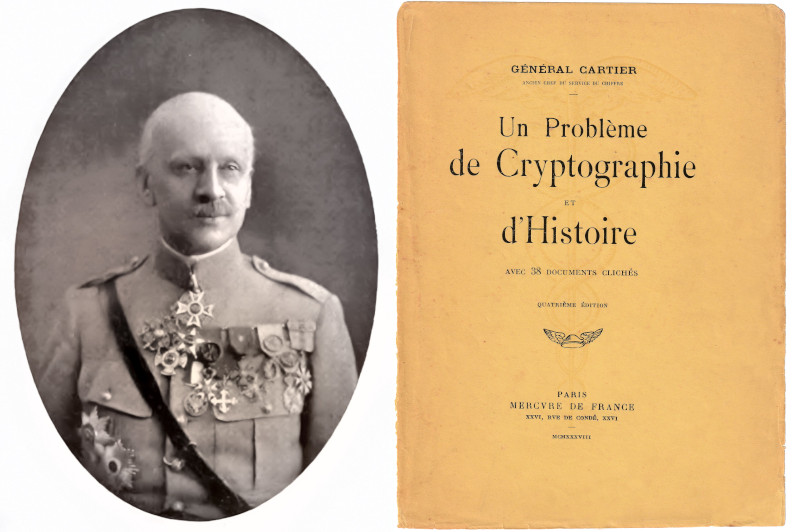
By the time all searches and analyses of materials for the article on Cartier in Wikipedia could be considered complete, a rather unpleasant thing became apparent. Unpleasant both for professional historians of cryptography and personally for the author of this text (writing on historical topics from the position of a curious amateur, particularly attentive to omissions and inconsistencies in details).
The unpleasantness is that almost all detected texts by historians containing information about François Cartier are filled with numerous factual errors, distortions, and inaccuracies. The reasons that give rise to a multitude of errors and distortions in the publications of professionals logically should be sought with them. As for the attentive amateur author who discovers these errors when comparing publications with genuine historical documents, they can only apologize to the readers. For in their previous texts, they carefully reproduced the mistakes of professional historians — as they previously did not have the original documents at hand...
To better illustrate what is meant here, it would be useful to provide a couple of specific examples from our own publications on Cartier. Where, by carefully citing knowledgeable historians, we inadvertently ended up propagating others' mistakes.
A typical first example is the prevalent mentions by historians that Cartier joined the army after graduating from l’X, as the Ecole Polytechnique is traditionally called in France. However, according to documents from Cartier's personal file in the archive of the Order of the Legion of Honour, he began his military service at the rank of second lieutenant immediately after finishing school, joining the Metz Artillery School at the age of 16 (later also receiving higher education at X).
Another common example is the continuous confusion with the naming of the cryptographic service of the French army that Cartier headed during World War I. In various authoritative sources, it's referred to as the Cipher Bureau, the Cipher Section, the Cipher Service, or something else entirely. To make matters worse, the cryptographic services of the two separate departments, the Ministry of War and the General Staff, are often confused. This is quite understandable, considering that soon after the war ended, both special services merged into one.
Such minutiae, which do not alter the essence of history, could be overlooked, if not for three more serious circumstances. Firstly, nowhere, neither on the internet nor in library catalogs, is there found ANY — even brief — biographical work by historians covering all stages of General François Cartier's life.
Secondly, when amateur researchers like us have the opportunity and desire to prepare such a comprehensive biographical overview but clearly lack the archival documents that are undoubtedly possessed by historians, any attempts to acquire them end up in vain. Because all requests to share the files that scholars have are consistently met with a wall of silence. Not a single historian of cryptography, to whom we reached out via email, responded to letters about Cartier.
Thirdly, in historical publications where François Cartier is mentioned, up to the present day, vile and sticky falsehoods about the general's affairs sporadically appear. Yet, for a long time, there have been ample opportunities to convincingly demonstrate with reliance on documents not only that this is deliberate falsehood, but to clearly see the details of the fabrication: when, where, how, by whom, and with whose initiation this falsehood was crafted and printed.
In sum, based on collected facts, documents, and testimony, a standard-format Wikipedia article about the life of François Cartier has been prepared, covering all periods of his biography. Such an article has been glaringly missing in encyclopedias for at least the last seventy years.
As missing or unknown documents gradually appear on the internet, new facts will naturally be added to the article. But the main thing is to start.
CARTIER, François (Article for Wikipedia)
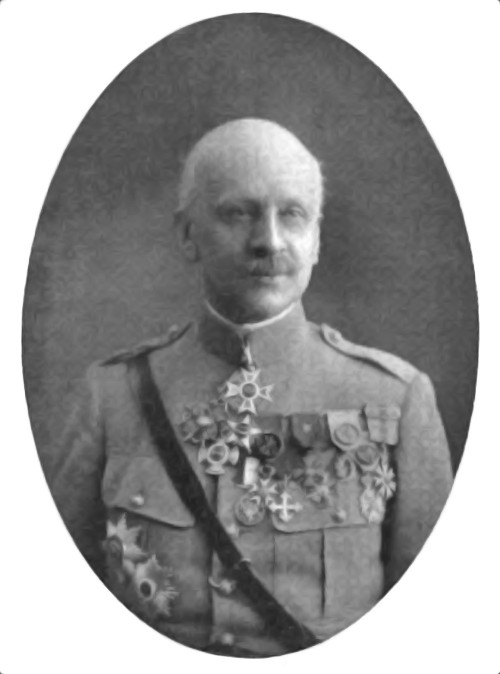
Biography
Born: December 5, 1862, Chasseneuil-sur-Bonnieure, Charente department
Died: June 15, 1953 (aged 90), La Rochelle, Charente-Maritime department
Nationality: French
Education: Metz Engineering Artillery School (Fontainebleau, 1879 – 1882); Ecole Polytechnique (Paris, 1882-1886)
Fields: Artillery and military intelligence; cryptography and radio communications; popularizing science and history
Other information
Branch: Corps of Engineers, Communications
Rank: Brigadier General
Awards: Commander of the Legion of Honor
Archives with personal file documents: SHD, Historical Archive of the Ministry of Defense (Service historique de la Défense, case GR 13 YD 973, Dossier personnel de François Cartier); Archive of the Order of the Legion of Honor (Base Leonore, case 19800035/61/7465 Dossier de François Cartier)
François Cartier (December 5, 1862, Chasseneuil-sur-Bonnieure — June 15, 1953, La Rochelle) — an outstanding French military cryptographer, who in the first third of the 20th century played a key role in establishing modern cryptology as an engineering-applied branch of mathematical science. Head of the Cipher Service of the French Ministry of War during World War I. Thanks to the impressive deciphering successes of his department, he became the first cryptographer in French history to achieve the rank of general.
After completing his military service in 1922, he actively engaged in the popularization of scientific and technical achievements in the fields of wireless communications and cryptography. A series of Cartier's publications (a cycle of articles and a book based on them) under the general name "The Problem of Cryptography and History" garnered special societal attention and were dedicated to the important role of ciphers in the long-standing debates about the true author of Shakespeare's works.
After meticulously analyzing Bacon's biliteral cipher, the signs of its application in numerous old books from the 16th-17th centuries, and the secret messages detected there, Cartier made three definitive conclusions as a cryptographic expert. Firstly, encrypted messages are indeed present in the texts of old printed books. Secondly, the detected secret messages are correctly deciphered in general. And thirdly, this entire set of deciphered documents not only reveals unknown secrets about Francis Bacon's biography and the hidden history of Elizabethan England but also unequivocally points to Bacon as the author of Shakespeare's works.
During Cartier's lifetime, no one could refute with evidence these conclusions of the authoritative professional, which were firmly backed by cryptographic analyses of documents but diametrically contradicted the established scientific views on England's history during Shakespeare's era. After the general's death, however, this became the main reason for the unspoken "taboo on Cartier." Thus, up until 2025, there were no biographical articles about him or even mentions of General François Cartier in encyclopedias and similar reference publications, let alone his monograph, which is extremely inconvenient for historians.
Biography
Early years
François Cartier was born in the small provincial town of Chasseneuil-sur-Bonnieure, Charente department. Despite his low social background (his father was a farrier, and his mother a housewife without profession [1]), he managed to obtain a good school education in the lyceum and college of Angoulême [2], the administrative center of Charente, located 20 km from Chasseneuil-sur-Bonnieure. After graduating from college in 1879, at age 16, Cartier linked his life to the army by entering the Metz Engineering Artillery School. [1]
In 1882, to obtain higher engineering-mathematical education while serving in the military, Cartier entered the Ecole Polytechnique in Paris. He completed his education in 1886, after which he served for five years in the 3rd Engineer Regiment in Arras, where Cartier's career quickly advanced from a lieutenant 2nd class to a captain 1st class in 1891. [1]
Concerning the period of military service from 1891 to 1900, Cartier's personal file contains only a vague note about some "special mission for the Municipal Commission." In memoirs written by Cartier in his advanced age after World War II, he mentions briefly working for military intelligence during this period. [3]
Starting in 1900, a significant turn occurred in the direction of Cartier's service activities when one of his recent superiors, General Penel, took position as Inspector General of the Military Telegraphy Service at the Ministry of War. At the same time, Penel became chairman of the Military Cryptography Commission, with François Cartier serving as the commission's secretary.
At the turn of the 19th-20th centuries, not only the French armed forces but also those of other countries lacked units that constantly dealt with cipher issues for protecting their own secret communications and decrypting enemy correspondence for intelligence purposes. The important new role of cryptography in military-political affairs began to be understood with the widespread adoption of wireless radio communication, which radically changed the speed and effectiveness of communications and provided large arrays of valuable intelligence information. [4]
An excellent engineering education in applied mathematics and physics, coupled with an influential position at the Ministry of War overseeing both cryptography and radio communications — not to mention his knowledge of intelligence work and evident organizational talents — were factors that clearly played their part in having François Cartier in the right place at the right time.
From 1900 to 1912, F. Cartier was not only the permanent secretary of the Military Cryptography Commission but became the first to understand the need to create permanent cryptographic bodies within the armed forces. In 1908, he managed to convince first the Minister of War and then the heads of other ministries of the need for an interdepartmental cipher committee — to establish a unified government approach to cryptography across all ministries. [5]
Soon such a committee was indeed created, led by François Cartier, who in 1909 received the next military rank of major. The accompanying practical successes of Cartier's initiatives in selecting capable officers and training them in the basics of cryptography, strengthening France's ciphers, and intercepting-decrypting German communications (as the main potential enemy) ultimately led to the decision to create a permanent cryptographic special service within the armed forces.
In 1912, the appropriate unit was created under the name Section du Chiffre, or the Cipher Section of the War Ministry (later Service de Cryptographie, the Cryptographic Service) with Major Cartier at its head. In the same year, Cartier met with Marcel Givierge, a talented cryptanalyst officer and polyglot translator, who became his deputy and closest ally for many years to come.
Despite the service's very small initial staff (only 4 people), the range of tasks assigned to the new service was quite extensive from the start [6]:
— on the one hand, organizing the encryption and decryption of telegrams within the War Ministry's communication;
— on the other hand, the development, production, dissemination, and accounting of encryption means, performed with the involvement of the officers of the Cryptographic Commission;
— lastly, analytical research in the fields of cryptographic strength and breaking of ciphers.
In addition to all this, a separate number of difficult tasks soon emerged, primarily falling on Cartier's shoulders:
— organizing and developing secure radio communication channels with Russia (protocols, codes, and so on);
— compiling a common Franco-English dictionary for ally codes;
— organizing and expanding posts for intercepting foreign communication lines.
For these new challenges, it was necessary for Cartier to make several trips in 1913-1914 to England and Russia, as well as to Algeria and Morocco. [6]
In the same period, Cartier became the organizer of the first cryptography training courses at the Ecole supérieure de Guerre (Superior School of Warfare), established in 1913. And starting in 1914, under the undeniable influence of Cartier, it was possible to attract a significant number of qualified mathematicians and engineers from the graduates of the Ecole Polytechnique to work in the cryptographic special service. [5]
World War I and assesments of personal contribution
Thanks to all these advance efforts, by the start of World War I, which broke out in the summer of 1914, France was the only power whose army cryptographers already had a functioning structure not only for protecting their own lines of communication but also for intercepting, breaking codes, and reading the enemy's secret correspondence. [4]
A vast range of organizational and technical measures, in which François Cartier played a central role, ensured that by 1914 France had significant cryptological superiority and achieved extensive intelligence successes throughout the war by mass-decrypting enemy dispatches. So much so, that after the victorious end of World War I, French Prime Minister Georges Clémenceau noted Cartier's personal contribution with the words: "He was more useful to our country than an army corps." (« Il fut plus utile à notre pays qu’un corps d’armée ») [7]
During the war, Cartier frequently interacted with cryptographers from allied countries out of duty and eagerly shared his acquired experience, assisting them in mastering new intelligence and information protection technologies. This experience was especially valuable for the very young cryptographic service of the US Army, created in 1917.
Lieutenant Colonel Frank Moorman, who commanded the American unit G2A6, engaged in signals intelligence and cryptanalytic cracking of German codes within the AEF, i.e., the US Armed Forces Expeditionary Force in France, described Cartier in his official report summarizing G2A6's work as someone who was always “ready, willing, and able to help us at all times. His advice and assistance have been of the greatest service to us.”. In a personal letter of thanks sent to Cartier after the war, Frank Moorman expressed the same sentiment with these words [8]:
“we have considered you the father of our section and have never hesitated to appeal to you in difficulty. You have always been ready to help us and be able to overcome the obstacles, and without you our service would have lost a lot of value...”
In 1954, shortly after the 90-year-old general's death, the then head of the Cipher Section in the French Armed Forces Secretariat, Lieutenant Colonel E. Arnaud, prepared a brief biographical note on Cartier, stating his place and role in the history of cryptography as follows [8]:
“In 1912 he [General Cartier] was appointed Head of the Cipher Section at the Ministry of War, and he remained in this position until 1921. It was during that period, and primarily during the war of 1914 - 1918, that his great competence and the distinguished record of the group of cryptologists inspired by him brought his name into prominence and gave him a fame which spread beyond the frontiers of France. The name of General Cartier is destined to remain in the roll of first-rate cryptologists in the history of national and international cryptography, as much for the direction and impetus which he gave to cryptographical research as for the invaluable successes scored under his leadership.”
Interwar Period
In 1921, François Cartier became the first military cryptographer to receive the rank of general. In the same year, the leadership of France decided to merge the cryptographic services of the War Ministry and the General Staff. The new unified cryptographic service within the General Staff was headed by Lieutenant Colonel Marcel Givierge, while General Cartier, who had a year left until retirement, was appointed military governor of Dunkirk. [6]
In December 1922, when Cartier turned 60, he ended his military service with the rank of reserve general and actively switched to journalistic popular science activities in periodical print.
It is remarkable, that his first notable article, titled "The Problem of History and Cryptography" [10], which François Cartier published at the end of 1921 while still completing his work in the cryptographic special service, was signed not under his real name but with the initials of the pseudonym "H.C.". All of his subsequent publications in the following years were signed as "Général Cartier", which led to long-lasting misunderstanding regarding his name. For several subsequent decades, mentions of cryptographic publications by this author often listed his name as General Henry Cartier. [11]
General Cartier's interest in the Bacon-Shakespeare "problem of history and cryptography" attracted the American tycoon George Fabyan, who owned a private cipher bureau as part of his own Riverbank Laboratories and actively participated in the creation of the US Army's cryptographic service. Before the US entered the war in 1917, Fabyan's cryptographers were exclusively engaged in developing the theme of Bacon's biliteral cipher in old books of the 16th-17th centuries. When it became clear that the American army had no own cipher specialists, Fabyan not only provided his cryptographers as instructors to train about a hundred military cryptanalysts, but also provided the Army with valuable officer personnel — in the face of Riverbank employees like John Powell and William Friedman. [8]
John Powell, attaining the rank of captain, served during the war as a liaison officer between American cryptointelligence and cryptographer colleagues in France and the United Kingdom. And Lieutenant William Friedman also in France was breaking German ciphers as part of Frank Moorman's G2A6 unit.
Through whom, Powell or Friedman, George Fabyan contacted General Cartier after the war is not precisely known. But it is reliably known that Fabyan's materials on the topic of Bacon's biliteral cipher sparked genuine interest in the French cryptographer. Cartier's own analysis of differences in typefaces and the reading of fragments encrypted with them in old books convinced him that secret messages did indeed lie hidden there.
A significant outcome of these analytical works was Cartier's extensive series of publications from 1921-1923 in the magazine Mercure de France. Initially, he described in detail the principles of detecting and reading Bacon's cipher in printed books of the Elizabethan era [10], and then, in the series of articles "The Bacon-Shakespeare Mystery: A New Document" published the "Secret Biography of Francis Bacon, encrypted with his biliteral cipher" [12]. These materials were also received by Cartier from Fabyan and decrypted by Elizabeth Gallup, who was then working at Riverbank.
In the same year, 1923, but in a different journal about radio communications, Radio-Électricité, Cartier published a large and often cited by historians of cryptography article in two parts with details of the work of radio interception reconnaissance services during World War I. [13]
In 1924, continuing his publications in the popular science genre, Cartier wrote an article for the illustrated magazine La Science Moderne (Modern Science) offering a general overview of the history of cryptography and methods of breaking ciphers. [14]
Then, in 1925-1926, followed a large seven-part series of Cartier's cryptographic articles "Secrecy of Radiotelegraphy" — with an expanded review of the latest encryption systems based on electromechanical cipher machines. [15]
The noticeable — and contagious — activity of the authoritative general-cryptographer, who managed to awaken a clear interest in the history of cryptography and the latest technical achievements in encryption automation among the general public, had a marked influence on other colleagues in cryptographic special services.
Thus, Cartier's closest associate, Colonel and later General Marcel Givierge, also began publishing popular science articles on cryptography and ciphers in open press in 1922. In 1925, he released an entire textbook "Cryptography Course" [16], which specialists evaluated as "undoubtedly the best and most important book on cryptanalysis ever published [until the middle of the 20th century]" [11]. More than half a century later, it will become known that it was precisely the textbook by Givierge that taught codebreaking to those young Polish mathematicians who, before World War II, would manage to crack the German Enigma cipher, long considered "unbreakable." [17]
In the same 1925, another of Givierge's and Cartier's close associates during the war, Commander E.-A. Soudart in collaboration with colleague A. Lange, published their extensive "Treatise on Cryptography" [18]. In Italy, a similar guide was published by military cryptographer (later General) Luigi Sacco [19]. All these works, it should be particularly emphasized, were published openly in the mass media — because such was the "spirit of the time" in the post-war 1920s.
Therefore, it is not surprising that in the USA, William Friedman, at that time already the leading cryptologist of the American army, was also closely following the rise of this "first wave of open cryptography" in Europe and joined the general trend. In 1927, for the new 14th edition of the Encyclopaedia Britannica, in addition to the existing "Cryptography" article, he prepared his own large and informative article "Codes and Ciphers" about "modern, highly scientific" cryptosystems. [20, Item 8]
Meanwhile, General Cartier began engaging in the popularization of scientific and technical achievements in the field of communication on a permanent basis. Considering the rapidly developing radio communication in those years as a new and effective means of disseminating knowledge available to all, Cartier established regular columns not only in the already mentioned Radio-électricité journal, but also in several other periodicals on radio communication, such as QST Français and La Radio-Agricole. Where he monthly explained to readers not only the basic principles and phenomena of physics at the foundations of communication technologies, but also the latest inventions like television, electronic music, and radio-controlled driverless vehicles. [21]
Cartier's active work in the popular science field did not go unnoticed, so that in the early 1930s, from the "serious science" camp, he began to be ironically referred to as "the great scientist of periodic radio publications for everyone." [22]. Simultaneously, noteworthy publications by military cryptographers on the history of ciphers, the art of breaking them, and the mathematical foundations of cryptology began to rapidly dwindle (or rather, move to secret military archives). The last of such books published on the eve of World War II appeared to be General Cartier's monograph.
Main Book: The Problem of Cryptography and History
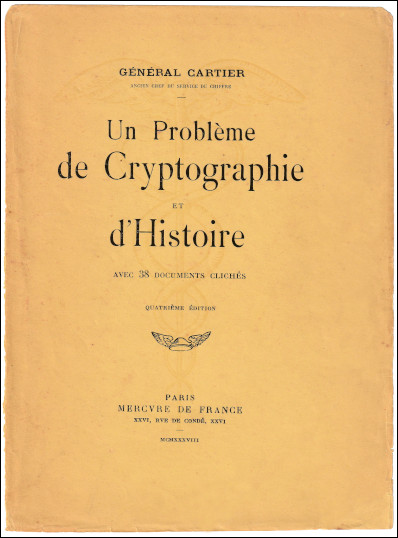
In 1938, Cartier published his Opus Magnum, the book "The Problem of Cryptography and History" [23], where he collected and supplemented all his previous publications on Bacon's ciphers in old printed books and their decisive role in the ongoing debates about the true author of Shakespeare's works.
This book from the outset had a complicated and strange fate. For the rare combination of General Cartier's high authority as an experienced military cryptographer and the extremely inconvenient conclusions for official history that Cartier made as a professional from analyzing Bacon's ciphers and secret messages — all this certainly required some substantive reaction from competent authorities.
Reaction to Cartier's book soon indeed followed, but it was peculiar in its duplicity.
On the one hand, as early as 1939, the well-known American journalist Fletcher Pratt, who specialized in military history topics, published a new noteworthy book "Secret and Urgent: The Story of Codes and Ciphers" [24]. In this work, there was essentially laid the basic template for how almost all subsequent historians of cryptography would write about Cartier: (a) readily acknowledging the indisputable successes of cryptographer Cartier during World War I; and (b) completely ignoring Cartier's book, not mentioning it in those chapters of history where the role of Bacon's ciphers in debates about the authorship of Shakespeare's works is discussed.
On the other hand, however, precisely at this time, but only in deep secrecy from everyone, the US Navy's cryptographic intelligence began recruiting Shakespeare scholars and other textologists for secret courses where they were trained in the espionage art of cryptanalysis. So that in the soon-followed World War II, many famous American Shakespearians (Fredson Bowers, Charlton Hinman, Giles Dawson, Ray O. Hummel) successfully engaged in breaking enemy ciphers as part of naval intelligence. [25]
In other words, the evident interest of the US intelligence-cryptographic special services in the Bacon-Shakespeare era ciphers in general and in General Cartier's book, in particular, was initially a strictly secret subject. This interest would begin to manifest in a more open form significantly later, about a decade after the end of the war.
World War II and Postwar Years
In 1939, when a new major war broke out, General Cartier, whose age was approaching 80 years, wrote a letter to the General Staff of the French army expressing his willingness to return to military cryptographic service [26]. This offer, however, was not taken up by the authorities.
As for other famous military commanders-veterans of World War I, such as Marshal Petain and General Weygand, their return to service ultimately ended in the disgrace of military defeats and accusations of treason for collaborating with the Nazi occupiers — with trials and imprisonments in the postwar period.
What General Cartier did during the war and occupation is not reported by any cryptography historian. But from Cartier's personal file in state archives, it is documented that shortly after the war, in 1949, he was awarded for the third time France's highest national order of merit — as a Commander of the Legion of Honour. The first two degrees of this award — Chevalier and Officer of the Legion — were received by him in 1903 and 1916. [1]
In the summer of 1953, General Cartier died at the age of 90. In the last years before his death, he wrote memoirs, the full content of which remains practically unknown to the general public even today. All of the General's recollections naturally focused on the cryptography and intelligence affairs he engaged in throughout the main part of his military career. But after World War II, the state's attitude towards cryptography secrets had already become far different than it was in the 1920s.
For this reason, when Cartier's daughters decided to publish their father's memoirs after his passing, they didn't manage to release them as a single book [26]. Competent authorities divided the memoir chapters into two parts, one of which [27] was published in 1958 in the internal "Bulletin of French Crypto Service Veterans" (where it remains inaccessible to other readers), and the other part [28] was published in 1959 in the open communications-themed journal Revue des Transmissions (and notably, the issue with Cartier's memoirs was the journal's last one).
In other words, in today's online library archives, including the BnF (National Library of France), and elsewhere on the internet, Cartier's memoirs can't be found. But instead, it's easy and without problems to find books and other publications that spread proven falsehoods about General Cartier. And these fictions are spread at the behest of rather renowned authors.
Compromising Lies, Taboo on Mentions, and Restoring the Truth
William and Elizebeth Friedman's Book
Practically immediately after Cartier's death in July 1953, in the fall of that year, the Folger Shakespeare Library in Washington (famous for its largest collection of printed books from the time of Shakespeare and Bacon) announced a contest for the best work on the literature of the Elizabethan era. Notably significant participants of this contest were veteran cryptographers of the American intelligence services, the spouses William and Elizebeth Friedman.
This participation was notable because William Friedman would later receive the status of "father of American cryptology," and at that time he held the post of "special assistant to the director of the NSA." The National Security Agency of the USA was created in 1952 so that its very existence was initially a serious state secret. And employees of this Agency were categorically forbidden from revealing their affiliation to the new cryptographic special service and from speaking publicly on the subjects of ciphers or cryptanalysis. [29]
Why precisely in this case an exception was made for William Friedman remains unknown to this day. However, it is well known that the book The Shakespearean Ciphers Examined written rapidly by the Friedmans during 1954 was not only announced the winner of the Folger contest but was also soon published in a mass edition in the US and the UK. [8]
Since then and up to the present time, this book by authoritative American cryptographers is the main and final argument in disputes about the role of ciphers in the evidence of the true authorship of Shakespeare's works. For, according to the categorical and quite unequivocal conclusion of the Friedmans, there are simply no ciphers in the books of the Shakespearean era. And everyone who thinks otherwise either knows nothing about the subtleties of cryptography or has become a victim of self-deception.
One of such "victims of self-deception" in this case was also General François Cartier, whose book the American cryptologists subjected in their work to the most scathing criticism — for insufficiently thorough analyses of materials for an experienced cryptographer. It was easy and simple for the Friedmans to criticize Cartier's book, as the deceased general could no longer respond to such arranged criticism in any way. For other authoritative cryptographers, the problems of Shakespearology were too far removed from the urgent — and extremely secret — tasks of their profession in that period.
An extensive critical comparison of these two books — by the French general and his American critics — conducted by an experienced analyst-cryptographer of a Russian intelligence service, will emerge only many decades later, in the 2020s. And all documents, facts, and evidence gathered in this new research ultimately testify that the book of the Friedman spouses represents a deliberate disinformation constructed from deceits, omissions, and factual distortions. [30]
The foundation of this big lie was the complete omission by the Friedmans of an undeniable fact that in their youth, working at Fabyan's Riverbank Laboratories, they themselves not only did identify and successfully decrypted Bacon's secret messages in Shakespeare's books but also made training manuals to help everyone master these skills. Documents personally signed by them — manuals by William Friedman and decryptions by Elizebeth Smith Friedman made with these manuals' assistance — have survived to the present day. But awareness of them came only in the 21st century. [31]
David Kahn's Book
In 1967, journalist David Kahn published the monumental tome "The Codebreakers" [4], now revered as the "bible of cryptography historians" and simply as the most informative work on this subject among everything published in the 20th century. However, in those sections of the book where Kahn writes (or, conversely, does not write) about the role and place of General Cartier in the history of cryptography, he did exactly the same as Fletcher Pratt in "Secret and Urgent" [24] thirty years earlier.
On the one hand, in the chapter on World War I, David Kahn tells much and in detail about Cartier's outstanding achievements. On the other hand, in the chapter on "The Pathology of Cryptology," as Kahn ironically termed all attempts by amateurs to decrypt Shakespearean texts to prove Bacon's authorship, there is not a single mention of the work "The Problem of Cryptography and History" from the experienced French general.
In his book, David Kahn unconditionally and entirely accepts Bacon-Shakespeare views of William Friedman, whom he refers to as "the world's greatest cryptologist." And along the way, relying on the words of Friedman (with careful reference to him in the notes), he also initiates a malicious falsehood about General Cartier in the history of cryptography. So according to Kahn’s book Cartier, in the early 1920s, allegedly tried to steal Friedman's authorship of his most famous cryptanalytic work (page 376 in [4]):
“Riverbank Pamphlet No. 22, written by Friedman in 1920, must be considered the most important among separate cryptology publications. Titled "The Index of Coincidence and Its Applications in Cryptography", this pamphlet provided such a machine for new cryptanalysis methods that it pushed cryptology as a science into a new world. In 1922, to save money, Fabyan decided to print this pamphlet in France. Where it was seen by General Cartier, who valued it so highly that he ensured its immediate translation and publication, even placing a false date "1921" on it, to make it appear as if this French work was the first to come out!”
The documentarily confirmed truth about this misunderstanding looks significantly different. In fact, Fabyan at Riverbank had his printing house, which was quite modern for those times. Where he printed all Riverbank publications, immediately placing his copyrights on them as the owner, and the real authors' names of works were usually not indicated.
Friedman's manuscript work "The Index of Coincidence" (Pamphlet No. 22) was prepared by him in 1920 but immediately not printed, as at the end of the same year the Friedman spouses fled from Riverbank to Washington. The copyrights for all their Riverbank works remained with Fabyan. In 1921, when Fabyan, deprived of his main cryptanalysts, was through correspondence with Cartier attracting the general's interest in Baconian ciphers, he sent him several Riverbank pamphlets to impress the French cryptoservice head with the level of specialists of his laboratories.
Impressing General Cartier was indeed successful. To such an extent that Cartier personally translated the anonymous manuscript and, in the same year, ensured its prompt publication at the Fournier printing house in Paris, as "Publication No. 22. Translation into French" [32]. The following year, when this brochure was printed in English at the same printing house, Cartier sent several copies to Fabyan in the USA. Since the same publication was printed in Riverbank in 1922, the French translation came out a year before the English original.
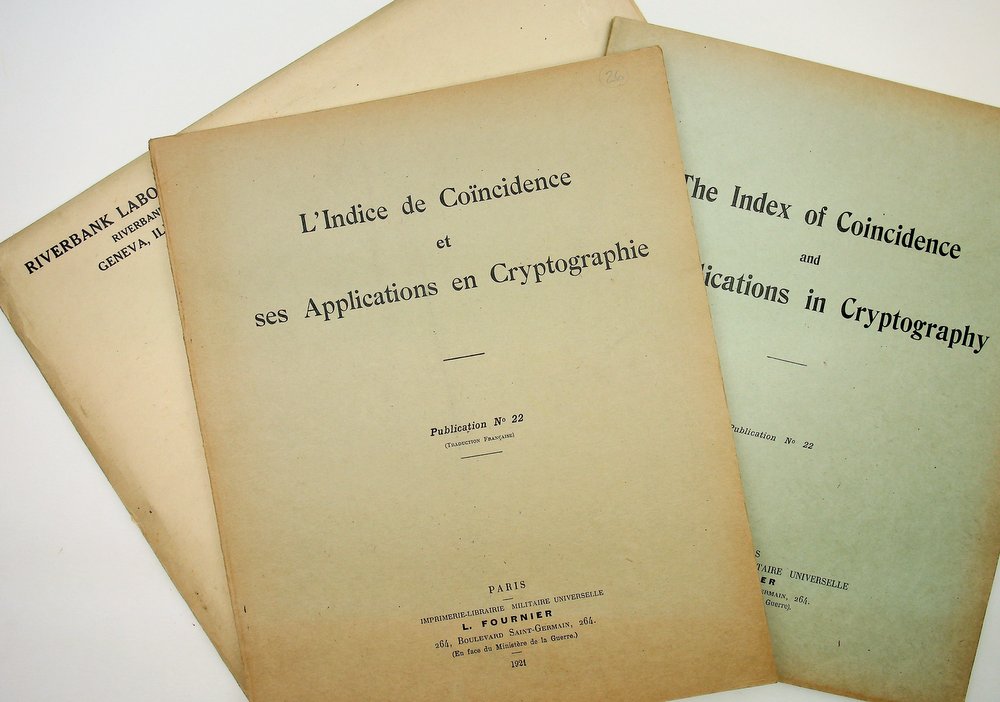
The truth about this really intricate story, in which Cartier could not have known the genuine author of the brochure, was carefully restored in 2014, in the "Guide to the Friedman Cryptologic Collection" by military historian Rose Mary Sheldon [20, item 167]. However, in almost all other publications on the history of cryptography, from Kahn's book to the present day, words of falsehood persist, claiming that General Cartier tried to pass off William Friedman's most important work as his own. [33]
Ladislas Farago's Book
In the same year of 1967, when David Kahn's work "The Codebreakers" was published, another notable book on the role of cryptography in history appeared a few months earlier: "The Broken Seal" [34] by Ladislas Farago. Already a well-known journalist and writer at the time, L. Farago worked for the US Navy Intelligence during the war and in his new book revealed a multitude of previously unknown details about the rivalry between the American and Japanese cryptoservices, which broke each other's ciphers in the period between the world wars.
In other words, to the hero of the First World War, French General Cartier, and his postwar Bacon–Shakespearean research, this work by Farago seemed to have no relation at all. However, this book was the first to present unexpected information about Cartier, suggesting that he not only sold his cryptographic knowledge to foreign states but specifically, in the late 1920s, actively strengthened the cryptographic potential of militaristic Japan. The corresponding fragments from Farago's book look like this in verbatim quotes:
"[Foreign Ministry Cable Section Chief] Shin Sakuma was not a professional cryptographer but a career Foreign Service officer. ... [Knowing about cryptanalitic successes of the US intelligence], Sakuma decided to seek means to improve the safety of his Ministry's classified traffic. The Japanese imported a Frenchman, regarded at that time as the world's foremost cryptographer. He was Brigadier General Henri [sic] Cartier, whose verts — transcripts of decrypted German messages distributed in France on green foolscap — had contributed materially to the Allied victory in World War I."
"After leaving the French army in 1919, he became available as a consultant and thus worked for various foreign governments as well as individuals."
"He did much to improve Japan's crypto-system by training a new generation of native cryptologists and by developing a series of complex codes and ciphers. His most important contribution, however, was his contagious enthusiasm for cryptographic machines at a time when many of the professionals were still opposed to them."
The most remarkable feature of the quoted passages is that over the more than half-century period following the publication of Farago's "The Broken Seal," no cryptographic history research has been found to document or corroborate this episode with credible evidence.
It is also indicative that when David Kahn prepared his wealth of similar information in the monograph "The Codebreakers," he used, judging by the references, the same sources as Ladislas Farago. However, there's absolutely nothing mentioned about the French general's cryptographic business as a consultant to Japan or other foreign states in Kahn's book. Instead, there is the following paragraph in the notes to the chapter discussing Japanese cryptography between the world wars [4, p. 978]:
"Other information that came to my attention too late to include in my text is in Ladislas Farago, The Broken Seal (New York: Random House, 1967). Farago’s material must, however, be used with great caution, as it has many errors."
Taboo on Mentioning Cartier's Book and Restoring Historical Truth
In 1950, under the auspices of the Folger Shakespeare Library, the international scholarly journal Shakespeare Quarterly was established, regularly publishing research on all aspects of Shakespeare's works and the literary-theatrical life of his era. Over its more than 70-year history, this journal has published all those Shakespeare scholars who worked as cryptographers for intelligence during the war (Fredson Bowers, Charlton Hinman, Giles Dawson, Ray O. Hummel). Similarly, cryptographers William and Elizebeth Smith Friedman are not only mentioned there but have also been published themselves multiple times.
However, there are no mentions of François Cartier's book, "The Problem of Cryptography and History," on the pages of Shakespeare Quarterly. Furthermore, throughout this journal's history, even the name of General Cartier, who wrote about the role of ciphers in the Bacon–Shakespeare question over the years, is never mentioned.
When it comes to cryptography's history, a very similar picture is observed with an unspoken taboo on mentioning work inconvenient for all. Starting with Kahn's book "The Codebreakers" and the appearance of the journal CRYPTOLOGIA in 1977, which remains the main regular publication for cryptographic historians, General Cartier's name is consistently mentioned either in studies of World War I or in the postwar misunderstanding with the author of the Riverbank brochure on the Index of Coincidences. Cartier's work, "The Problem of Cryptography and History," is completely shunned in CRYPTOLOGIA's journal or any other publications on the history of cryptography over the past half-century. In essence, this book was erased from history.
A very gradual return of the complete historical truth about General Cartier's works began in 2020. This is best noticed against the backdrop of a parallel quiet reassessment of William F. Friedman's role and place in the 20th-century cryptography history.
First, in the early months of 2020, through a series of simultaneous publications in central media outlets in the USA, Germany, and Switzerland, the world learned about "Operation Rubicon" – dubbed as "the greatest intelligence operation of the century," which lasted over half a century on this planet [35]. Its essence was that initially, in the mid-1950s, US and German intelligence services recruited Boris Hagelin, owner of the Swiss firm Crypto AG, and then from 1970, they became its secret owners. So, until 2018, Hagelin's cipher machines, sold to almost 130 countries, had artificially weakened cryptoschemes, allowing American and German intelligence agencies to quickly and easily read all the secret correspondence closed by these ciphers.
This plot is directly related to General Cartier's history because William F. Friedman was at the origins of Operation Rubicon. Thanks to his long-standing acquaintance and friendly relationship with Boris Hagelin, he became not only the "access agent" but also the recruiting officer who personally persuaded the Crypto AG owner to collaborate secretly with intelligence [36]. Notably, this took place in 1954-1957 during Friedman's multiple visits to Switzerland and other European countries. That is, simultaneous with preparing and publishing the Friedmans' book The Shakespearean Ciphers Examined. [8]
In other words, it happened that at the same time, the "great cryptographer and father of American cryptology" Friedman was actively involved in two major deceptions. In international relations, compromising the particularly popular Hagelin ciphers worldwide, and in the field of Shakespeare studies and history, compromising the genuinely substantive cryptanalytic work of General Cartier.
Why it coincided like this is unknown, but at the end of 2020, shortly after the truth about Operation Rubicon and W.F. Friedman's key role in it emerged, General Cartier's book "The Problem of Cryptography and History" resurfaced online from complete oblivion [23]. A series of online investigations into the chapters of this monograph and the circumstances of related life activities of cryptographic services ultimately resulted in the book "4in1: Mask of Shakespeare and Mysteries of Bacon, Book by Cartier and Secrets of the NSA" [37].
A byproduct of this book was the creation of the 4in1.ws website, accumulating materials from new cryptographic investigations of the Bacon–Shakespeare problem, as well as the historical documents and publications underlying these investigations.
Thanks to all these materials, it became possible to create this Wikipedia article, restoring in history the name and deeds of the undeservedly forgotten cryptographer-general François Cartier.
Honours and decorations
List of main awards, according to the data from Cartier's files in the archives of the French Ministry of Defense [38] and the Legion of Honour [1]:
- Legion of Honour: Chevalier (October 12, 1903), Officer (December 25, 1916), Commander (October 4, 1949)
- Croix de guerre (War Cross) 1914-1918
- Inter-Allied Victory Medal
- Officer of the Order of Leopold I (Belgium)
- Knight of the Order of Saint Michael and Saint George (United Kingdom)
- Officer of the Order of Saints Maurice and Lazarus (Italy)
- Commander of the Order of the Ouissam Alaouite (Morocco)
- Distinguished Service Medal (USA)
Main Works by General Cartier
(1921-1922) Un Problème d'Histoire et de Cryptographie. Mercure de France; Paris: No. 563, 1 Dec 1921; — —, No. 568, 15 Fevrier 1922
(1923) Le Mystère Bacon-Shakespeare. Un document nouveau. Mercure de France; Paris: No 581, 1 Sep 1922; No 582, 15 Sep 1922; No 591, 1 Fevr 1923; No 596, 15 Avr 1923; No 601, 1 Juill 1923
(1923) Le service d'écoute pendant la guerre, Radio-Électricité, Tome IV — No 16, 1 November 1923; Tome IV — No 17, 15 November 1923
(1924) Generalities sur la cryptographie. La Science Moderne, Paris, April 1924, No. 4
(1925-1926) Le secret en radiotélégraphie. Radio-Électricité, Tome VI — No 97, 10 Dec 1925; No 98, 25 Dec 1925; Tome VII — No 99, 10 Jan 1926; No 103, 10 Mars 1926; No 106, 25 Avril 1926; No 112, 25 Juillet 1926; No 113, 10 Aout 1926
(1938) Un problème de Cryptographie et d'Histoire. Paris: Editions du Mercure de France, 1938
(1958) "Mémoires du Général Cartier" (posthumous publication). Bulletin de l'ARC, May-July 1958, No. 1-2, pp 13-22 ; Bulletin de l'ARC, December 1958, No. 3-4, pp 25-61
(1959) "Souvenirs de Général Cartier" (posthumous publication). Revue des Transmissions, 1959, No. 85, pp 23-39; Revue des Transmissions, 1959, No. 87, pp 13-51
References
[1] Base Leonore – Dossiers de la Légion d'Honneur. Dossier 19800035/61/7465 de François Cartier https://www.leonore.archives-nationales.culture.gouv.fr/ui/notice/68036
[2] Chronique locale: Les anciens élèves du collège et du lycée d'Angoulême. La Charente, 28 Juin 1924
[3] Sophie de Lastours. La France gagne la guerre des codes secrets. Tallandier, coll. Documents d'Histoire, 1998
[4] David Kahn. The Codebreakers: The story of Secret Writing. New York, Macmillan Company, 1967
[5] Sébastien-Yves Laurent. About Professionalisation in the Intelligence Community: The French Cryptologists (ca 1870 – ca 1945). Lecture Notes in Computer Science 9100, Springer-Verlag Berlin 2016
[6] Louis Ribadeau Dumas. Chiffreurs et Decrypteurs français de la guerre 14-18. Bulletin de l'ARCSI n°27 – 1999 https://www.arcsi.fr/doc/BulletinARCSI1999_ChiffreursDecrypteurs1418.pdf
[7] Mémoires du Général Cartier. Préface de L. R.-D. Bulletin de l'ARC, mai-juillet 1958, No. 1-2, p 13
[8] Betsy Rohaly Smoot. From the Ground Up: American Cryptology during World War I. Ft. George G. Meade, MD: National Security Agency, Center for Cryptologic History, 2023 https://media.defense.gov/2023/Jan/26/2003150273/-1/-1/0/WWI_Book_02142023.PDF
[9] William F. Friedman and Elizebeth S. Friedman, The Shakespearean Ciphers Examined: An Analysis Of Cryptographic Systems Used As Evidence That Some Other Author Than William Shakespeare Wrote The Plays Commonly Attributed To Him (Cambridge University Press, 1958), pp 248-249
[10] H.C., Un Problème d'Histoire et de Cryptographie. Mercure de France; Paris: No. 563, 1 Dec 1921; —-, No. 568, 15 Fevrier 1922
[11] Joseph S. Galland, An Historical and Analytical Bibliography of the Literature of Cryptology. Evanston, Ill.: Northwestern University Press, 1945
[12] General Cartier. Le Mystère Bacon-Shakespeare. Un document nouveau. Mercure de France; Paris: No 581, 1 Sep 1922; No 582, 15 Sep 1922; No 591, 1 Fevr 1923; No 596, 15 Avr 1923; No 601, 1 Juill 1923
[13] General Cartier. Le service d'écoute pendant la guerre, Radio-Électricité, Tome IV — No 16, 1 November 1923; —-, Tome IV — No 17, 15 November 1923
[14] General Cartier. Generalities sur la cryptographie. La Science Moderne, Paris, April 1924, No. 4, pp. 212-220.
[15] General Cartier. Le secret en radiotélégraphie. Radio-Électricité, Tome VI — N° 97, 10 Dec 1925; N° 98, 25 Dec 1925; Tome VII — No 99, 10 Jan 1926; No 103, 10 Mars 1926; No 106, 25 Avril 1926; No 112, 25 Juillet 1926; No 113, 10 Aout 1926
[16] Marcel Givierge. Cours de cryptographie. Paris: Berger-Levrault, 1925
[17] Marian Rejewksi. Memories of My Work at the Cipher Bureau of the General Staff Second Department 1930–1945. Adam Mickiewicz University Press, Poznan, Poland (2011)
[18] Andre Lange et Emile-Arthur Soudart, Traite de cryptographie: études sur les écritures secrêtes, Paris: Librairie Felix Alcan, 1925
[19] Luigi Sacco (Generale). Manuale di crittografia. 2a edizione, riveduta e aumenta. Roma, 1936 (First edition was released in 1925 under the name Nozioni di crittografia.)
[20] Rose Mary Sheldon (2014) The Friedman Collection: An Analytical Guide. Archived: Way Back Machine https://web.archive.org/web/20211101214514/https://www.marshallfoundation.org/library/wp-content/uploads/sites/16/2020/01/Friedman_Collection_Guide_September_2014.pdf
[21] Général François Cartier: Chronology of the Bibliography
[22] Marcell Boll. L' "éthéromanie" des militaires (Paul Brenot, Henri Cartier…), et autres profanes. Mercure de France, No 762, 15 Mars 1930, p 660
[23] François Cartier, Un problème de Cryptographie et d'Histoire. Paris: Editions du Mercure de France, 1938 https://archive.org/details/un-probleme-de-cryptographie-et-d-histoire/
[24] Fletcher Pratt. Secret and Urgent: the Story of Codes and Ciphers. Indianapolis: Bobbs-Merrill, 1939
[25] G. Thomas Tanselle, The Life and Work of Fredson Bowers. Studies in Bibliography 46 [1993]: 1–154, esp. 32–34
[26] Agathe Couderc. Sous le sceau du secret: les coopérations internationales des Chiffres britannique et français, militaires et navals pendant la Première Guerre mondiale. Histoire. Sorbonne Université, 2022 https://theses.hal.science/tel-04815492v1
[27] "Mémoires du Général Cartier." Bulletin de l'ARC, mai-juillet 1958, No. 1-2, pp 13-22 ; Bulletin de l'ARC, décembre 1958, No. 3-4, pp 25-61
[28] "Souvenirs de Général Cartier." Revue des Transmissions, 1959, No. 85, pp 23-39; Revue des Transmissions, 1959, No. 87, pp 13-51
[29] David A. Hatch, The Editor's View. NSA Cryptologic Quarterly, Issue 2015-01, Volume 34, pp 2-3
[30] Bacon's Cryptography and the Anatomy of Self-Deception. By idb & friends, BACONIANA, Volume 2 No 1, 8 November 2024 https://francisbaconsociety.co.uk/wp-content/uploads/2024/11/BACONIANA-2024.pdf
[31] Bacon cipher collection, Manuscripts and Archives Division, The New York Public Library. https://archives.nypl.org/mss/176
[32] L'Indice de coincidence et ses applications en Cryptographie, Riverbank Publications, No. 22, Paris: L. Fournier, 1921
[33] David Kahn (2002): A Riverbank Trove, Cryptologia, 26(3):161–164; Chris Christensen (2013): Review of "Memories of My Work at the Cipher Bureau of the General Staff Second Department 1930-1945" by Marian Rejewski, Cryptologia, 37:2, 167-174; David Sherman (2017): The National Security Agency and the William F. Friedman Collection, Cryptologia, 41(3):195-238; Shawn Rosenheim (2019). The Cryptographic Imagination: Secret Writing from Edgar Poe to the Internet. Johns Hopkins University Press.
[34] Ladislas Farago. The Broken Seal: The Story of 'Operation Magic' and the Pearl Harbor Disaster. New York: Random House, 1967
[35] The intelligence coup of the century: For decades, the CIA read the encrypted communications of allies and adversaries. By Greg Miller. The Washington Post, 11 February 2020 https://www.washingtonpost.com/graphics/2020/world/national-security/cia-crypto-encryption-machines-espionage/
[36] Operation RUBICON: The secret purchase of Crypto AG by BND and CIA. Crypto Museum https://www.cryptomuseum.com/intel/cia/rubicon.htm
[37] idb & friends, 4in1: Mask of Shakespeare and Mysteries of Bacon, Book by Cartier and Secrets of the NSA. 4in1.ws, 2023 https://4in1.ws/
[38] Service historique de la Défense, GR 13 YD 973 — Dossier personnel de François Cartier
Further reading
David Kahn. The Codebreakers: The story of Secret Writing. New York, Macmillan Company, 1967
Sophie de Lastours. La France gagne la guerre des codes secrets. Tallandier, coll. Documents d'Histoire, 1998
Louis Ribadeau Dumas. Chiffreurs et Decrypteurs français de la guerre 14-18. Bulletin de l'ARCSI n°27 – 1999 https://www.arcsi.fr/doc/BulletinARCSI1999_ChiffreursDecrypteurs1418.pdf
Sébastien-Yves Laurent. About Professionalisation in the Intelligence Community: The French Cryptologists (ca 1870 – ca 1945). In «The New Codebreakers. Essays Dedicated to David Kahn on the Occasion of His 85th Birthday» (LNCS 9100), Springer-Verlag Berlin 2016
Agathe Couderc. Sous le sceau du secret : les coopérations internationales des Chiffres britannique et français, militaires et navals pendant la Première Guerre mondiale. Histoire. Sorbonne Université, 2022 https://theses.hal.science/tel-04815492v1
Betsy Rohaly Smoot. From the Ground Up: American Cryptology during World War I. Ft. George G. Meade, MD: National Security Agency, Center for Cryptologic History, 2023 https://media.defense.gov/2023/Jan/26/2003150273/-1/-1/0/WWI_Book_02142023.PDF
External links
4in1: Mask of Shakespeare and Mysteries of Bacon, Book by Cartier and Secrets of the NSA
General François Cartier: the cryptographer who was nearly erased from history: part 1, part 2, part 3, part 4, part 5