Général François Cartier. Part 2 of 5: Chronology of the Bibliography
The continuation of the series about collecting materials on the cryptographer general François Cartier. Or, in other words, a visual guide for research like "How to change the course of history, at least the part that has already happened." [i1]
The publication of the previous — that is, the first — episode of this cycle took place on December 5, 2024. It ended with a phrase about the persistent search and "assembling bit by bit" of any substantive information on Cartier. Life, however, arranged it so that thanks to the well-known (but still surprising) mechanism of synchronicities, almost simultaneously with our publication — in the early days of December 2024 — a gift appeared on the internet. In the form of a voluminous new dissertation examining the activities of French cryptographers during the First World War. [o1]
And since it is reliably known that François Cartier was one of the main figures of that major history, it's easy to surmise that the seven hundred pages of the new work certainly already compile a mass of substantial information about the man who created and successfully led the French crypto service during the war years. Collected precisely the information, in other words, that we intended to painstakingly seek out in disparate and hard-to-access sources...
An old story in a new way
The title of the successfully defended doctoral dissertation at the Sorbonne by historian Agathe Couderc in full reads approximately as follows: "Under the Seal of Secrecy: International Cooperations of the French and British Army and Navy Cipher services during the First World War" [o1].
As expected, in this extensive work, the name François Cartier is mentioned not just frequently but very frequently. But, to our great regret and disappointment, practically all this information contains almost nothing new for us. Because it merely deepens and clarifies the details of that story which was already long known thanks to The Codebreakers by David Kahn (which Couderc's dissertation abundantly references over 30 times).
But if one studies the sections of the new research particularly interesting to us, which talk about the post-war activities of military cryptographers and their numerous publications on ciphers in the years between the world wars — there's virtually nothing substantial about General Cartier's notable activity in the field of Baconian cipher analysis in ancient books. Except for a single footnote number 20 on page 523, where among other references to the Bacon-Shakespeare debates are mentioned — without any comments — several of Cartier's articles in the Mercure de France journal.
However, it's hard not to notice that the previous footnote number 19 on the same page is dedicated to the publication of the famous cryptanalytic work of William Friedman "The Index of Coincidence", first published in 1921 in French in a translation by General Cartier (noted in the footnote). In other words, there is no doubt that Agathe Couderc is well-acquainted with all the nuances of this multilayered and confusing story, in which the Bacon-Shakespeare debates of historians and literary scholars are closely intertwined with the analytical works of respected military cryptographers.
But, which must be particularly emphasized — in Couderc's voluminous research, there is not a single mention of the most important Bacon-Shakespeare works in this series. Neither of Cartier's book Un problème de Cryptographie et d’Histoire [o2] nor of Friedman's (with his wife) book The Shakespearean Ciphers Examined [o3]. And there is a strong sense that this was done quite intentionally by the historian.
Because the exact same thing is done in the synchronously released book by another – American – historian Betsy Rohaly Smoot, addressing the same topic from a slightly different angle: From the Ground Up: American Cryptology during World War I [o4] (it should probably be noted here that although Couderc's dissertation is just now published, it was written earlier and defended in December 2022, after which a kind of two-year "embargo" was imposed on its publication). In B. Smoot's large work, published in January 2023, Cartier, Friedman are frequently (and even the Bacon-Shakespeare ciphers sometimes) mentioned. But nowhere is there any mention or word about the important and diametrically opposed in conclusions books by the two cryptologists on this subject. [i2]
In other words, in the latest publications of cryptography historians, a clear intention can be seen by scholars to bring back into the discourse the name and deeds of General Cartier, who was nearly entirely and clearly unjustly erased from history. But they are trying to do so now in a way that his outrageous and inconvenient for all book about Bacon as Shakespeare remains outside the discussions.
Because the taboo on Cartier's book has not been lifted...
Compartmentalization, Denial and Deception, Plausible Deniability
To make it clearer how deep and serious such taboos are, approaching the explanations will have to be done from afar.
The "4in1" investigation [i3], with which in 2020 began the return of General Cartier into history, opened with such a — somewhat enigmatic — paragraph:
In the foundations of cryptography as a solid scientific computer- mathematical discipline there lies a big Mystery of the occult- mystical sense. By a long-standing tradition, it is forbidden to talk about this Mystery. But by whom it is forbidden and on what grounds, actually, no one knows…
The status of this big Mystery, which is quite evident, remains unchanged to this day. Here, explaining how and why (and since when) people have been persistently concealing information really important to everyone, is most conveniently started with the logo — or "coat of arms" — of an interesting organization called ARCSI.
The meaning of this abbreviation in a loose translation from French to English sounds approximately like this: "Association of Veterans of Crypto Services and Information Security" (Association des Réservistes du Chiffre et de la Sécurité de l'Information).
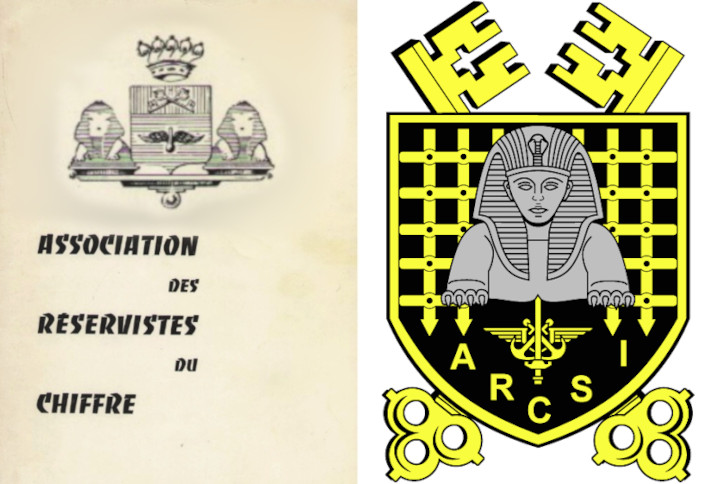
Here, naturally, there won't be a detailed analysis of all the elements of this curious logo, but the symbolism of the central figure — the Ancient Egyptian Sphinx — certainly deserves an elaborated commentary. But a commentary, let's emphasize, on those hidden meanings of the symbol that the French veterans of cryptology and information security likely didn't even imply for their logo.
Firstly, because the Sphinx is a symbol of that same unspoken Mystery. Secondly, because this Mystery goes back to Ancient Egypt times. Thirdly, it is directly related to important knowledge and occult sciences that hide this Mystery. And fourthly, this concealment is done with the help of ciphers, compartmentalization of information, and introducing confusion, deception, and denial, as well as relying on various other methods of misinformation from the arsenal of modern intelligence agencies.
What ciphers are, there is no need to explain. However, illustrating the essence of other methods of information protection and knowledge concealment, starting with compartmentalization (segmentation) [i4] and deliberate confusion, is beneficial to do using historical examples.
When the ancient Greek "father of history," Herodotus, traveled to Egypt in the 5th century BCE, knowledgeable local priests explained to him that the gods of the Egyptians and Greeks were actually the same characters. The ancient supreme god Amon of the Egyptians became Zeus among the Greeks, the god Ptah became Hephaestus, the goddess Neith became Athena, and so on.
Why the Egyptian god of wisdom Thoth, who gave people writing and counting, crafts, and agriculture, became the cunning god Hermes (patron of thieves and trade) among the Greeks is not explained by Herodotus. But everyone familiar with the religion and mythology of Ancient Greece probably knows that wisdom was embodied by the warlike goddess Athena. The one who brought the Olympian fire and light of knowledge to people was named the rebellious Prometheus (temples in his honor were not built by the Greeks to avoid angering their jealous gods). By this interpretation, Hermes, as the embodiment of cunning and theft, turned out to be the "most logical" substitute for Thoth in the ancient Greek pantheon...
In other words, the mechanisms of compartmentalization or segmentation of information are such that different people, calling the same things by different names, often start interpreting events not just very differently, but sometimes with exact opposite meanings. Especially in cases when confusion is created intentionally. So a benefactor of humanity is ultimately named a thief and rebel, and the most important of the knowledge given by him is hidden and vanishes in deep secrecy from everyone, as dangerous heresy "hermeneutics." [i5]
Another powerful method of manipulating knowledge and truth is known as "Denial and Deception." [i6]
In the late Renaissance, when intellectuals distinctly began to lean towards a rational explanation of the world combined with the revival of "Egyptian magic," seekers of knowledge had to be particularly cautious. Thus, the secret brotherhood of the Rosicrucians, which emerged shortly after the brutal execution of Giordano Bruno, burned at the stake for his unyielding dissent and free-thinking, made anonymity or "invisibility" one of the main principles of their activities.
The Rosicrucians' deliberate withdrawal from publicity proved so successful, and their secret "scientific-magical" discoveries were hidden so deeply that this entire stratum of 17th-century European culture remains poorly mastered by science until today. For instance, the active participation of Francis Bacon in Rosicrucian activities appears to most modern historians as a doubtful myth. Not to mention that until recently, the Rosicrucians themselves were interpreted as a sophisticated hoax and mystification. [i7]
So when it began to emerge that Francis Bacon left behind a multitude of encrypted documents, peculiar things started happening with these materials. Since these documents contained details not only about Bacon's secret biography but also about his literary work under the name of Shakespeare and other famous English authors, and not to mention the Rosicrucians' secret experiments with nature, this whole array of new facts and evidence was very resolutely rejected by the scientific community. Because it demanded a fundamental reexamination of too many established narratives — from the history of England and Europe, literature and theater, science and religion, and up to rethinking the structure of physical reality in the light of successful scientific-magical experiments of the Rosicrucians...
In short, a categorical Denial was imposed on the entire array of encrypted documents of Bacon. Because such a thing simply cannot exist, as it cannot exist at all. And to ensure that no new researchers would attempt to independently repeat the experiments with Bacon's decryption (not to mention the Rosicrucians' experiments [i8]), a grand Deception was constructed. In the form of a book [o3] by the most authoritative cryptographers of the USA, William F. Friedman and Elizebeth Smith Friedman. They very categorically assured everyone from the height of their cryptanalytic experience and mastery that they had not found any Baconian ciphers in the old books. Therefore, there was nothing to decrypt.
But it so happened that our main character, General-Cryptographer François Cartier, conducted his own extensive work on the analysis of Bacon's ciphers over thirty years earlier than the Friedmans' book release. And eventually came to a diametrically opposite conclusion, with absolute certainty confirming not only the presence of Bacon's ciphers but also the accuracy of their decryption.
For this reason, what happened to General Cartier's works thereafter represents a very convenient and illustrative example to demonstrate another important principle in the basics of manipulating information and concealing of true knowledge. This trick is called Plausible Deniability.
The essence of the idea is quite simple. It boils down to making sure that when you have long and persistently asserted an apparent falsehood (or something else worse), everything should be arranged so that in case the real truth is revealed, there is always the opportunity to claim that the lie and confusion (or anything worse) did not come from you. And if it's indeed obvious whose doing it is, then the deceit here was not intentional.
A vivid confirmation of how this mechanism still operates regarding General Cartier can conveniently be examined in the example of BnF — the National Library of France, which is the main and largest library in the country.
National library of France: what's in the catalogs
Since all catalog data (at least for open access) at BnF is digitized and available online, finding the author card for François Cartier is not difficult. And it looks like this:
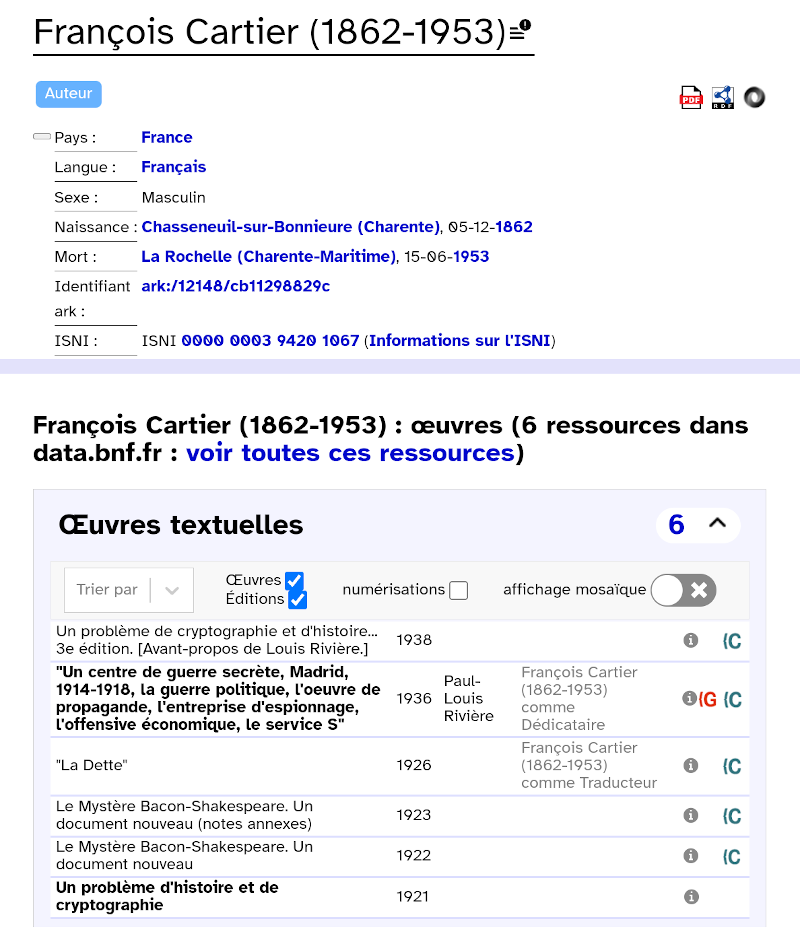
At first glance, this card, listing six works associated with the name of General François Cartier, may seem quite credible. Since it indeed lists not only well-known articles by Cartier from 1921-1923 on the topics of the cryptographic "Bacon-Shakespeare puzzle" but also his main 1938 book, which compiled previous journal publications under one cover.
With a slightly more thorough study of the card, however, signs of data manipulation become apparent. For instance, the book in the second line, for some reason highlighted in bold, actually has no connection to François Cartier's texts. Its author, journalist, and former military cryptographer Paul-Louis Rivière, simply dedicated his book to General Cartier.
But the preface to this book was written by another much more famous French General, Maxime Weygand. Infamously known in France for later becoming the Minister for Defense and Generalissimo of the Vichy regime during World War II, actively collaborating with Hitler's Nazis.
To clarify that neither J.-P. Rivière nor François Cartier were involved in the activities of the Vichy collaborationist regime, significant additional historical research is required. However, the format of the entries in the BnF catalog creates the impression that these authors are linked with the traitor M. Weygand…
However, the main issue with how General Cartier's works are reflected in the BnF catalog is, of course, not this. It's that all knowledgeable historians of cryptography are well aware of the fundamentally important work for them since 1945, Joseph Galland's An Historical And Analytical Bibliography Of The Literature Of Cryptology [o5]. And in this book, among many other things, information is collected about more than a dozen various publications by General Cartier. Not only on Bacon-Shakespeare, naturally, but also on the design of telegraph cipher machines, the history of radio interception services, and the general principles of cryptography and cryptanalysis.
Why none of these works are in the catalog of France's main library is something that cannot be answered here, of course. But it's entirely possible not only to correct and specify Galland's bibliography but also to significantly expand it — relying on the rich resources of the internet.
Fragments of bibliography with chronology and comments
This section contains detailed information about François Cartier's own texts, published in open print editions. It's more convenient to discuss the translations he made of other authors' works in the context of the following sections. As well as about the secret works of General Cartier, not yet published in open print, as far as is known.
1921
- H.C. , «Un Problème d’Histoire et de Cryptographie» . Mercure de France; Paris: No. 563, 1 Dec 1921, pp. 385-400
In December 1921, François Cartier's very first publication on the topic of Bacon-Shakespeare ciphers appeared in Mercure de France, Europe's oldest literary journal (dating back to the 17th century): "A Problem of History and Cryptography". In this same article, he discusses the cryptanalytic works of American Colonel Fabyan, who drew his attention to the study of the Bacon cipher in Elizabethan-era books.
Since, in 1921, General Cartier was still heading the French military cryptographic service, he signed his article not with his own name, but with the initials of the pseudonym "H.C.". This led to a persistent misunderstanding of the author's real name. So much so that until the late 1960s, references to a certain General Henry Cartier who was not, in fact, named Henry, but François, appeared from time to time in the publications of Baconians and cryptography historians.
Be that as it may, from 1922 onward, this author signed all his texts without first name at all – simply Général Cartier.
1922
- «Un problème d’Histoire et de Cryptographie (complément)» . Mercure de France; Paris: No. 568, 15 Fevrier 1922, pp. 116-124
The second part of the previous article from No. 563.
-
R.Q. Cryptographie (Général H Cartier). Mercure de France; Paris: No 567, 1 Fev 1922, pp. 790-796
-
R.Q. Cryptographie (M. le général Cartier). Mercure de France; Paris: No 569, 1 Mars 1922, pp. 502-505
Cartier's comments on readers' letters on the topic of cipher in the Baconian-Shakespearian debates.
-
Le Mystère Bacon-Shakespeare. Un document nouveau. Mercure de France; Paris: No 581, 1 Sep 1922; pp. 289-329
-
Le Mystère Bacon-Shakespeare. Un document nouveau (II). Mercure de France; Paris: No 582, 15 Sep 1922; pp. 604-656
The beginning of a large series of particularly interesting publications on the Bacon-Shakespeare topic. In the first two articles, in issues 581 and 582, chapters of Bacon's secret biography, told through his biliteral cipher, are presented. The texts were deciphered in the USA thanks to the work of Elizabeth Gallup and sent to General Cartier by Colonel Fabyan for expert analysis and evaluation by an independent specialist.
1923
-
Le Mystére Bacon-Shakespeare. Un document nouveau (Notes annexes A-I). Mercure de France; Paris: No 591, 1 Fevr 1923, pp. 603-635
-
Le Mystére Bacon-Shakespeare. Un document nouveau (Notes annexes K-R). Mercure de France; Paris: No 596, 15 Avr 1923, pp. 306-338
-
Le Mystére Bacon-Shakespeare. Un document nouveau (Notes annexes S-Y). Mercure de France; Paris: No 601, 1 Juill 1923, pp. 31-57.
Three concluding articles of the cycle "The Bacon-Shakespeare Mystery. A New Document". In these articles, collectively titled "Appendices and Notes" (numbered serially from A to Y), additional data and responses by the author to critical feedback or questions from readers about the first two publications in issues 581 and 582 of the Mercure de France of 1922 are collected.
-
«Le Chiffre de Bacon et le mystere Bacon-Shakespeare.» X Information. Bulletin mensuel polytechnicien, Paris, July 1923, pp. 32-36
-
«Le Chiffre De Francis Bacon», Fly Leaves of the Ladies’ Guild of Saint Albans, New Series No. 14, November 1923, pp. 316-319
Another two Cartier articles on Bacon ciphers and their detection-decoding in old Elizabethan books. One was published in the X Information bulletin of the École Polytechnique, the other in the "women's" English Baconian magazine. As of yet, neither publication has been found online.
-
«Le service d’écoute pendant la guerre» , Radio-Électricité, Tome IV — No 16, 1 November 1923, p. 453-460
-
«Le service d’écoute pendant la guerre (Suite et fin)» , Radio-Électricité, Tome IV — No 17, 15 November 1923, p. 491-498
A large and often cited by cryptography historians article by Cartier in two parts — with details about the work of communications interception services during World War I.
1924
- «Generalities sur la cryptographie.» La Science Moderne, Paris, April 1924, No. 4, pp. 212-220.
In 1924, the illustrated popular science magazine La Science Moderne (Modern Science) was revived in France. In one of the first issues, General Cartier published an article with a general review of the history of cryptography and codebreaking methods.
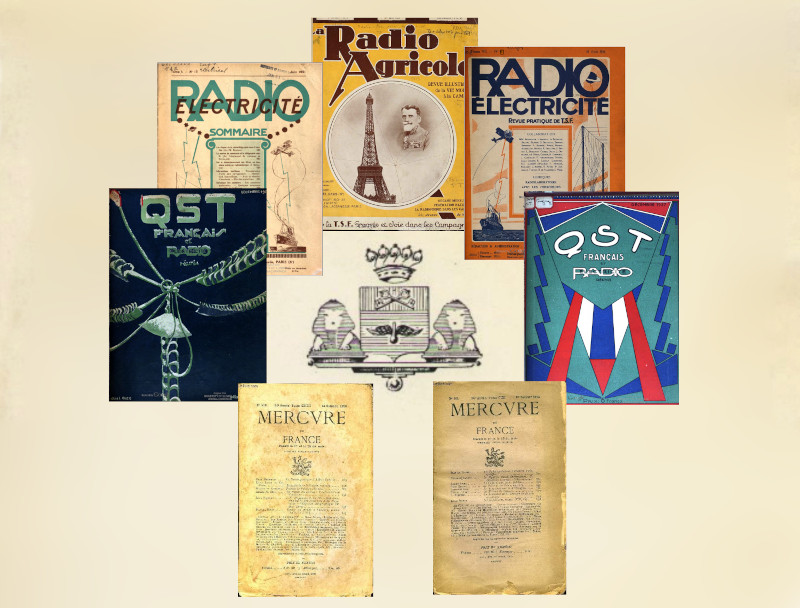
Around the same time, in March 1924, the first issue of the new magazine QST français was released, created for the technical education of radio amateurs and the popularization of new radio communication technologies. The magazine was created with the active participation of General Cartier, so almost every edition of this monthly publication, which ran from spring 1924 to fall 1926, contained Cartier's articles on the scientific and technical foundations of wireless communication:
-
«À propos de la radiophonie» , QST français, Paris: No. 1 – Mars 1924, pp 2-3
-
«Radiophonie et phénomènes de propagation» , QST français, Paris: No. 4 – Juin 1924, pp 6-13; No. 5 – Juill 1924, pp 6-17; No. 6 – Aout 1924, pp 6-9; No. 7 – Sept 1924, pp 6-14; No. 8 – Oct 1924, pp 6-16; No. 9 – Nov 1924, pp 6-11 ; No. 10 – Dec 1924, pp 6-20
1925
-
«Le secret en radiotélégraphie» , Radio-Électricité, 1925, Tome VI — N° 97, 10 Dec 1925, pp 444-445
-
«Le secret en radiotélégraphie» , Radio-Électricité, 1925, Tome VI — N° 98, 25 Dec 1925, pp 465-467
The beginning of an important cycle of 7 cryptographic articles "Encryption of Radiotelegraphy", discussing the principles of new encryption systems based on electromechanical cipher machines. Special emphasis is placed on the designs of the Swedish inventor A. Damm, which later became the prototypes for Hagelin encryptors, and the design of the American inventor Vernam, along with descriptions of several other curious cryptographic schemes.
- «Radiophonie et phénomènes de propagation» , QST français, Paris: No. 11 – Jan 1925; No. 12 – Fev 1925; No. 13 – Mars 1925; No. 14 – Avr 1925; No. 15 – Mai 1925; No. 16 – Juin 1925 ; No. 17 – Juill 1925 ; No. 18 – Aout 1925; No. 20 – Oct 1925
Continuation of a large cycle of articles on the science and technology forming the basis of radio communication.
1926
-
«Le Secret en radiotélégraphie (Électro-Cryptographe Damm)» . Radio-électricité, Tome VII — No 99, 10 Jan 1926, pp 6-10
-
«Le Secret en radiotélégraphie (Système Damm amélioré)» . Radio-électricité, Tome VII — No 103, 10 Mars 1926, pp 84-89
-
«Le Secret en radiotélégraphie (Système G.-S. Vernam)». Radio-électricité, Tome VII — No 106, 25 Avril 1926, pp 142-144
-
«Telegraphie et Radiotélégraphie secrète» . Radio-électricité, Tome VII — No 112, 25 Juillet 1926, pp 275-278
-
«Telegraphie et Radiotelegraphie secrète» . Radio-électricité, Tome VII — No 113, 10 Aout 1926, pp 297-301
Continuation and conclusion of the cycle of articles on new technologies and equipment for encrypting radio communications.
- «Quelques idées nouvelles au sujet des phenomenes de la Radiophonie» . Radio-électricité, Tome VII — No 111, 10 Juillet 1926, pp 249-252
Several new ideas about the physics of phenomena underlying radio communication.
-
«Radiophonie et phénomènes de propagation» , QST français, Paris: No. 22 – Jan 1926, pp 498-500; No. 23 – Fev 1926, pp 554-560; No. 24 – Mar 1924, pp 610-612; No. 25 – Avr 1926, pp 660-663; No. 26 – Mai 1926, pp 710-713; No. 27 – Juin 1926, pp 766-769 ; No. 28 – Juil 1926, pp 822-824 ; No. 29 – Aout 1926, pp 878-884 ;
-
—-, QST français et Radio-électricité réunis :No. 30 – Sep 1926, pp 15-20 ; No. 32 – Nov 1926, pp 3-5 ; No. 33 – Dec 1926, pp 3-4
Continuation of the large series of articles on the science and technology forming the basis of radio communication.
In September 1926, a merger between the journals QST français and Radio-électricité occurred, with which General Cartier regularly collaborated. In the following years, the merged journal slightly changed its name to Radio-électricité et QST français réunis.
- Une lettre (Gl. CARTIER), QST français et Radio-électricité réunis : No. 30 – Sep 1926, p 13
A welcoming letter from Cartier to the editorial team of the new merged journal.
1927
- «Radiophonie et phénomènes de propagation» , QST français et Radio-électricité réunis, Paris: No. 34 – Jan 1927, pp 3-7 ; No. 35 – Fev 1927, pp 3-5 ; No. 36 – Mar 1927, pp 3-5; No. 37 – Avr 1927, pp 3-4; No. 38 – Mai 1927, pp 3-5; No. 39 – Juin 1927, pp 3-4 ; No. 40 – Juil 1927, pp 3-4 ; No. 41 – Aout 1927, pp 3-4 ; No. 42 – Sep 1927, pp 2-3 ; No. 43 – Oct 1927, pp 3-5 ; No. 44 – Nov 1927, p 3 ; No. 45 – Dec 1927, pp 3-9
Continuation of the large series of articles on the science and technology forming the basis of radio communication.
1928
- «Radiophonie et phénomènes de propagation» , QST français et Radio-électricité réunis, Paris: No. 46 – Jan 1928, pp 3-5 ; No. 47 – Fev 1928, pp 2-3 ; No. 48 – Mar 1928, pp 2-4; No. 49 – Avr 1928, pp 2-4; No. 50 – Mai 1928, pp 3-4; No. 52 – Juil 1928, pp 2-4 ; No. 53 – Aout 1928, pp 2-5 ; No. 54 – Sep 1928, pp 2-8 ; No. 55 – Oct 1928, pp 3-4 ; No. 56 – Nov 1928, pp 3-7 ; No. 57 – Dec 1928, pp 2-5
Continuation of the large series of articles on the science and technology forming the basis of radio communication.
-
«Les appareils musicaux radioélectriques» , La Radio-Agricole No.3, Juillet 1928, pp 10-13
-
«La Télémécanique» , La Radio-Agricole No.4, Aout 1928, pp 4-5
-
«La transmission des images» , La Radio-Agricole No.5, Septembre 1928, pp 4-5
-
«La Télévision» , La Radio-Agricole No.6, Octobre 1928, pp 13-14
In 1928, again with active participation from General Cartier, a new journal was created for the implementation and adoption of radio communication technologies in rural areas: La Radio-Agricole: revue illustrée de la vie moderne à la campagne, or "Radio-Agricole: Illustrated Review of Modern Rural Life". For the initial issues of this new journal, Cartier prepared review articles on the latest scientific and technological achievements. These included, in particular, electric musical instruments, radio-controlled unmanned vehicles, wireless image transmission, and television.
1929
- «Radiophonie et phénomènes de propagation» , QST français et Radio-électricité réunis, Paris: No. 58 – Jan 1929, pp 3-5; No. 59 – Fev 1929, p 3; No. 60 – Mar 1929, pp 2-4; No. 61 – Avr 1929, pp 2-4; No. 62 – Mai 1929, pp 2-4
Completion of Cartier's large series of articles on science and technology in the fundamentals of radio communication.
In addition and development of this series, for the same journal, Cartier wrote a number of articles on the prospects of applications in radio communication of such recent theoretical science achievements as relativistic theory and quantum physics. Importantly, this was done with an emphasized reliance on the ether theory of Maxwell and Lorentz as the basis of electromagnetic phenomena:
QST français et Radio-électricité réunis, Paris:
-
«H.A. Lorenz» , No. 48 – Mar 1928, pp 2-4;
-
«Induction» , No. 63 – Juin 1929, pp 3-5;
-
«Le courant éléctrique» , No. 64 – Juil 1929, p 3;
-
«Les origines de la théorie atomique» , No. 65 – Aout 1929, p 2;
-
«Causerie de Sir Fleming» , No. 66 – Sep 1929, pp 3-4 ;
-
«Le courant continu» , No. 67 – Oct 1929, pp 3-4 ;
-
«Ondes longues et ondes courtes» , No. 68 – Nov 1929, pp 3-5;
-
«Réceptions successive» , No. 69 – Dec 1929, pp 3-4
1930
The vigorous activity of General Cartier in the field of enlightenment for radio amateurs and other people interested in scientific and technological progress clearly did not go unnoticed in major scientific circles. A characteristic reaction to this activity can be considered an irritated-ironic comment in the pages of the Mercure de France magazine: "On the etheromania of military men (Paul Brenot, Henri Cartier…) and other nonprofessionals" [L’ «éthéromanie» des militaires (Paul Brenot, Henri Cartier…), et autres profanes. Mercure de France, No 762 , 15 Mars 1930, p 660].
The author of this unflattering commentary was Marcel Boll, a well-known philosopher of science and rationalist of his time, who actively promoted the new physics ("abolishing" the ether) and regularly reviewed scientific news for Mercure de France. A month later, the editorial board of the magazine published Cartier's response to Boll's criticism:
- Une lettre du général Cartier. Mercure de France; Paris: No 764 , 15 Avril 1930, p 510
In his letter, Cartier first gallantly praised the critic's sense of humor, who had called him "the great scientist of periodic radio publications for everyone." He then recommended Boll not to attribute to Cartier what he did not claim, and suggested refuting the General's actual claims with arguments from more authoritative physicists than the personal opinion of the reviewer himself.
1938
- Un probleme de cryptographie et d’histoire. Paris: Editions du Mercure de France, 1938. 330 pp.
General Cartier's book "The Problem of Cryptography and History", where he collected and supplemented his publications from 1921-1923 on the topic of Bacon-Shakespeare ciphers in old books. Included in this book are texts received by the author from Fabyan, "The Secret Biography of Bacon, as he tells it in the biliteral cipher," deciphered thanks to the work of Elizabeth Wells Gallup.
The return to history of this tabooed and artificially silenced in science monograph of General Cartier is the focus of the online project 4in1.ws [i9] and the investigation "4in1: Mask of Shakespeare and Mysteries of Bacon, Book by Cartier and Secrets of the NSA" [i3], which forms the basis of the project.
1939
-
«Quelques précisions au sujet de l’acteur William Shakespeare» . Mercure de France; Paris: No 979, 1 Avril 1939, pp 92-109
-
«Le systéme cryptographique de Bacon» . Mercure de France; Paris: No 981, 1 Mai 1939, pp 687-693
-
«Un Danger des Perturbations cosmiques et de la T.S.F.» Mercure de France; Paris: No 985, 1 Juillet 1939, pp 69-77
Three more articles by General Cartier in the renowned magazine, covering characteristic topics for him: on ciphers, on Bacon as Shakespeare, and on the impact of cosmic disturbances on the quality of wireless communication.
1958-1959
After the death of François Cartier in the summer of 1953 at the age of 90, his daughters decided to publish the memoirs of the General, written mainly from memory in the post-war years (as Cartier had burned all the documents of his personal archive in 1940 due to the German occupation of France).
In preparing the General's memoirs for posthumous publication, it was decided to divide them into two separate parts and print them in different editions. Thus, one part was published in 1958 in the semi-closed Bulletin de l’ARC (Association of Veterans of the French Cryptographic Service), and the other part in the open journal Revue des Transmissions (interestingly, issue 87 with the conclusion of Cartier's memoirs also became the last for this journal).
-
« Mémoires du Général Cartier » (publication posthume),
Bulletin de l’ARC, mai-juillet 1958, No. 1-2, pp 13-22
Bulletin de l’ARC, décembre 1958, No. 3-4, pp 25-61 -
« Souvenirs de Général Cartier » (publication posthume),
Revue des Transmissions, 1959, No. 85, pp 23-39
Revue des Transmissions, 1959, No. 87, pp 13-51
The main feature of these intriguing memoirs is that historians of cryptography regularly mention and quote them, yet these documents have still not been posted online. Neither for free nor for a fee.
And our personal letters to scholar-historians - asking them to share the files they have - consistently lead to the same result. Absolute and total silence in response...
As for the other publications of General Cartier, almost everything listed here has been carefully collected and made available for researchers in our archive.
Additional Reading
[i1] The New History of Humanity (rus.)
[i2] History Science as an Art of Cutting Out
[i3] 4in1, or One More Book (rus.)
[i4] Computer from Scratch (rus.)
[i5] Mathematics of Toth and Physics of Khemenu (rus.)
[i6] Denial and Deception (rus.)
[i7] Bacon and the Rosicrucians (rus.); Bacon and Magic (rus.)
[i8] The Secret Science of Riverbank
[i9] The New Beginning, or "4in1" as "Foreign One" (rus.)
Main Sources
[o1] Agathe Couderc. Sous le sceau du secret : les coopérations internationales des Chiffres britannique et français, militaires et navals pendant la Première Guerre mondiale. Histoire. Sorbonne Université, 2022. Français
[o2] François Cartier, Un problème de Cryptographie et d'Histoire. Paris: Editions du Mercure de France, 1938
[o3] William F. Friedman and Elizebeth S. Friedman, The Shakespearean Ciphers Examined: An Analysis Of Cryptographic Systems Used As Evidence That Some Other Author Than William Shakespeare Wrote The Plays Commonly Attributed To Him. Cambridge: Cambridge University Press, 1957
[o4] Betsy Rohaly Smoot. From the Ground Up: American Cryptology during World War I. Ft. George G. Meade, MD: National Security Agency, Center for Cryptologic History, 2023
[o5] Joseph S. Galland. An Historical and Analytical Bibliography of the Literature of Cryptology. Evanston, Ill.: Northwestern University Press, 1945